🏷️ Collection as Teacher—Alternative object record: Five hairpins
Editorial note:
This work has been created in the context of the Bauhaus Open Studios programme with students from Cornell College of Human Ecology’s Department of Human Centered Design (studio lead: Catherine Kueffer Blumenkamp) in September 2023. Students were asked to select an object from CF+TC, and devise an alternative object record. Starting from the structure and information in the record, we encouraged them to explore ways to go beyond the visual and verbal description provided therein—sensory features, speculation—in order to describe their object’s specific qualities.
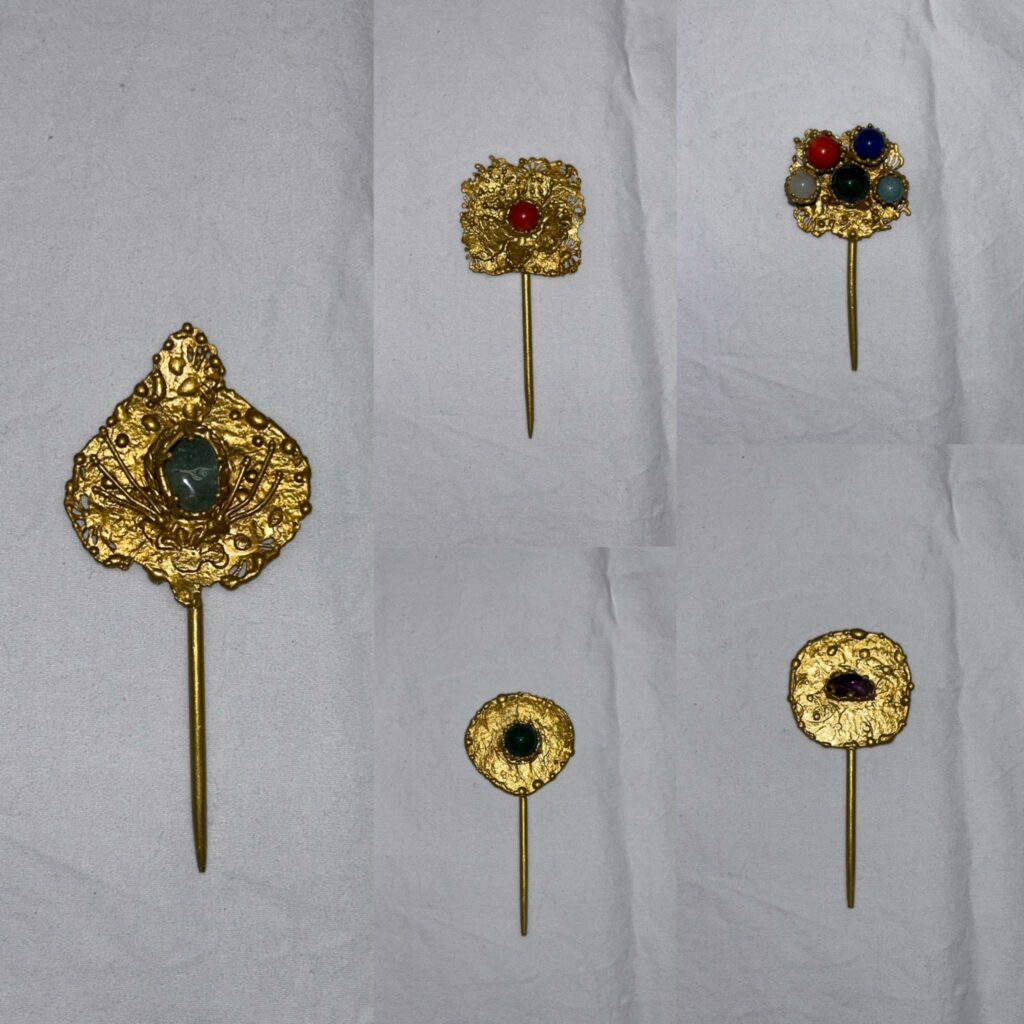

To engage with fashion is to synthesize a story. The context and manner with which one adorns the self are puzzle pieces to the art of documenting time, emotions, and identity; every work of fashion holds within it a montage of the past, present, and future. Objects no. 2023.19.001, 2023.19.002, 2023.19.003, 2023.19.004, 2023.19.005 in Cornell Fashion + Textile Collection, an assortment of five metal hair ornaments embellished with vibrant stones at the core, is a sterling instance of such storytelling.
Crafted by South Korean artist Seeun Kim, the pieces were inspired by the traditional tteol-jam and dwikkoji, hair accessories donned by women of higher social status in the Joseon Dynasty (1392-1910). While similar in appearance, the tteol-jam was worn on the front of the head whereas the dwikkoji was placed in the back. Widely generalized by the term, binyeo, the accessories are commonly characterized by a needle-like tip extending from a decorative piece of molded metal garnered by crystals such as coral, amethyst, and jade – intended to fix the ornament between tautly-braided locks of hair.
Against the backdrop of Korea’s final dynastic period, accessories served a diverse range of social functions; they were cherished as emblems of hierarchical standing, amulets to ward off evil, and adornments to achieve harmonization with dress.[1] However, as contemporary creations that bear an essence of modernity, the value of Kim’s work annexes beyond their conventional purpose – they are an embodiment of her aspiration to revive Korean traditional visual culture and sculpt its global presence.
“해” (pronounced: “hae”) was the first word to surface in my mind as my eyes swam through the elegant glimmer of the ornaments. The one-syllable term dissects into three distinct meanings, all of which I was astounded to find fitting of the artwork.
The first translation is “year”, which intermingles with the temporal concepts implied by the pieces. The intricate, sentimental architecture of Kim’s work orchestrates a finite yet eternal narrative of Korean visual culture. Despite their seemingly static appearance, the ornaments symbolically convey the movement of time, capturing Korea’s cultural history as well as its propagation to transnational contemporary art forms in years to come.
The word then denotes “sea”, a manifestation of the continental boundaries that Kim’s visions have crossed, the cultural distances they have traveled. While the origins of the artwork lie in the aesthetics of Joseon society, the metal craftsmanship implemented into its detail-oriented designs was acquired through Kim’s education in Shibuya, Japan. Such skills then journeyed with her to London, where she expanded the horizons of her artistic activity with the hope of shedding light on Korean visual history in the Western world.
Thirdly, the word signifies the sun, an immortal and singular concept. The golden gleam of the pieces resemble the unmatched omnipotence of the sun and its sense of eternal existence. The sunlight that synergizes with the luster of the ornaments to amplify such a dignified glint is the same light that illuminated daytime in the Joseon Dynasty – the sun is timeless.
So is Kim’s artwork, a chronicle of the coexistence of preservation and posterity.
[1] Sang Eun Lee. A Study of Formativeness Expressed in Korean Traditional Costume, in: Korea Science, June 2005, pp. 23–28 (available online).
is a sophomore from New York City pursuing an undergraduate degree in Communication at Cornell University’s College of Agriculture and Life Sciences. Her greatest interests revolve around the intersection of fashion, history, and society. In an effort to delve deeper into the diverse human stories that are narrated by dress and aesthetics, she is currently pursuing a Fashion Studies minor at the College of Human Ecology.