💼 The Design Student’s Bag: A Journey from Türkiye to the Bauhaus
Editorial note: Participants in the digital Bauhaus Open Studio are currently reflecting on what it means to be a design student in Türkiye today. In the studio, students are tasked to design their own “design student bag.” These bags embody their routines, tools, and needs and serve both as a mobile studio and a reflective diary. The first online session focused on material exercises and special documents from the historical collection.


The project is led by Katja Klaus and Philipp Sack from the Bauhaus Dessau Foundation, in collaboration with Koray Gelmez, Pelin Efilti, and Ali Cankat Alan from Istanbul Technical University. This initiative offers twenty design students from various Turkish universities the opportunity to exchange ideas in an international context. The highlight of the program is a visit to the Bauhaus in Dessau in April 2026.
For an in-depth look at the student projects, check out this note 💼💼💼
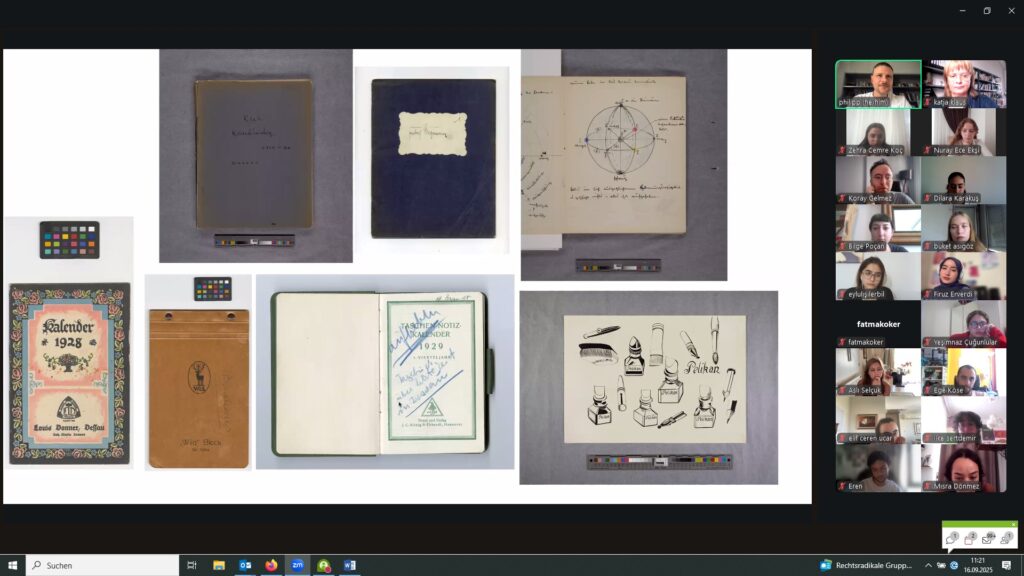
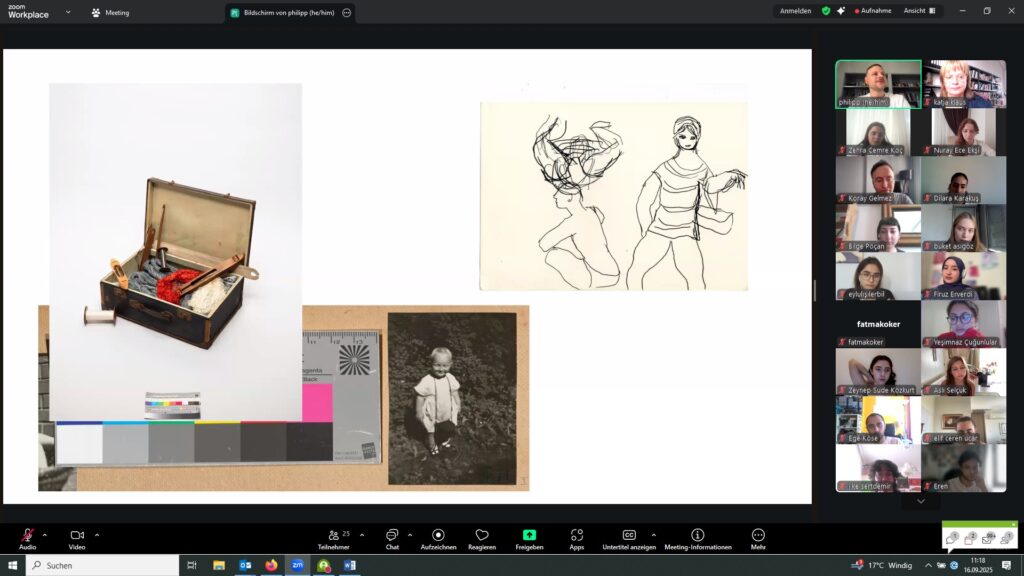
This year, we are starting your two-part Open Studio in digital form, and next year you will come to Dessau. How did your students react to the digital offer?
The response was very positive. When we announced the call in Türkiye, it quickly became one of the most significant international opportunities available to design students at the national level. We received 47 applications from 17 different institutions, which is quite a remarkable diversity and rarely seen in similar initiatives.
Because of this strong interest, student selection turned out to be a very challenging process. At first, we had planned for 12 participants, but due to the enthusiasm and quality of applications we had to increase the number first to 15, and finally to 20 students. We also received many personal e-mails from students expressing how meaningful this opportunity was for them and how much they wanted to be part of it. What truly demonstrated the students’ enthusiasm were the motivation videos they submitted as part of their applications. These clearly conveyed how much they valued the chance to participate in the workshop and, in particular, their excitement about engaging with the Bauhaus.
At the same time, the fact that the program begins in digital form was not perceived as a limitation but rather as an opportunity to create a shared virtual studio. Since students are based in different cities across Türkiye, the online stage allows them to remain connected while embracing diversity. To achieve this, we decided to use Instagram as our common platform (@thedesignstudentsbag). The students will jointly manage an account, respond to prompts we provide, and share their reflections and tasks there. This way, they can both follow each other’s journeys and make their processes publicly visible. The prompt-based online work will help them to stay virtually connected until they physically meet in Dessau, turning the digital stage into a meaningful first chapter of the journey.
What experiences have you had with online teaching in recent years?
Like many others, we started with online teaching as a necessity during the COVID-19 pandemic. That period was marked by urgency and a lack of preparation. However, in the years that followed, online teaching has become more balanced and purposeful. Today, it is possible to meet in the right online media whenever needed, and not only through live meetings.
Our experience has shown us that online teaching can also extend beyond conventional video sessions. Social media platforms, collaborative tools, and other communication channels can become part of the learning environment. This flexibility allows us to choose the most suitable medium for each pedagogical aim, making online teaching a more integrated and sustainable practice rather than a temporary substitute.
What tasks or assignment did your students work on in the session?
The workshop is structured around a series of milestones that gradually lead students from reflection to prototyping. We began with online prompts and a kick-off meeting, where students discussed what it means to be a design student today.
From there, they created touch boards to explore materials and haptic qualities, followed by institutional observations of daily student routines, tools, and learning spaces. These insights were then shared through a collective Instagram account, where each student produced a “Day in the Life” video as part of our first milestone.
How will you continue to work on this topic?
Later sessions focused on research synthesis and idea generation, where students translated their findings into early bag concepts, supported by both sketching and generative AI tools. They developed multiple concepts, presented mock-ups, refined their ideas, and moved into prototyping. Each stage involved documentation through photos, videos, and short reflections, all made publicly visible on Instagram.
Finally, before the Bauhaus visit in April 2026, students will prepare their bags to be used, filled with sketchbooks and tools, so that they can document, sketch, and reflect during their time in Dessau.
Beyond the visit, we plan to continue sharing outcomes through exhibitions, academic presentations, and publications, ensuring that the experiences and insights gained are disseminated to a wider design education community. The Instagram account will also remain active as a living platform, where the dialogue among students, educators, and the public can continue even after the formal end of the program. In this sense, “The Design Student’s Bag” is not only a workshop outcome but also a framework we intend to expand, connecting students from Türkiye with international peers and positioning their voices within broader conversations about design education.
With the experiential knowledge of the last few years, how will teaching in the field of industrial design continue to change?
Industrial design is, by nature, a flexible discipline that quickly absorbs and adapts to emerging technologies. The last few years have shown us that teaching will not return to a single fixed format, but will instead integrate a range of opportunities, from online platforms and digital collaboration tools to the new possibilities offered by AI.
We can expect design education to become increasingly hybrid, where physical studios remain central but are complemented by virtual spaces, prompt-based learning, and shared online environments. This combination enables students to experiment more broadly, connect across geographies, and engage with technologies that will inevitably shape their professional practice.
In this sense, industrial design teaching will continue to evolve as a responsive ecosystem, always integrating the tools and methods that reflect contemporary life and anticipating what comes next.