🕳️ Ecologies of absence: Experiment: Echo
Editorial note: This work has been created in the context of the Bauhaus Open Studios programme by students from the Academy of Fine Arts in Zagreb (studio leads: Nikola Bojić, Ivan Skvrce, Marko Tadić) in October 2025. Engaging with selected objects from the collection of the Museum of Contemporary Art in Zagreb (MSU)—textile fragments by Otti Berger, Ivana Tomljenović’s experimental film, and the correspondence of Marie-Luise Betlheim and Lou Scheper—the student research group explored not only what is present and preserved, but also what is absent and lost. They ask whether fragments can become active models for learning, and whether forms such as friendships, memories, and gestures of care can guide us in thinking about ecology, responsibility, and shared futures. Collections thus are not static repositories, but learning environments—ecologies in which human and non-human, personal and collective, past and present, remain fragmented and incomplete, yet living and entangled.
Ivana Tomljenović’s 1930 film is significant as the only known experimental film shot at the Bauhaus. Its creation by a female artist in a male- dominated context adds to its importance. The film innovatively explores everyday moments, reflecting Bauhaus principles, while also documenting the social life of Bauhaus students, showing them in informal situations such as sports, parties, and breakfasts. Architectural elements of the Bauhaus building are briefly captured, and the final frame, marked “ENDE,” playfully parodies contemporary cinematic conventions. Now digitized and held in the Museum of Contemporary Art in Zagreb, the film remains a rare and valuable resource for studying experimental art and early avant-garde filmmaking.
The video captured my attention in a special way, it felt complete, as if it were concealing something. Visually, it is striking, simultaneously unexpected and tense, yet intimate and serene. Unlike the other works in the collection, the video leaves little room for intervention, it is not a fragment.
The questions appeared: is there something hidden in the play of light and shadow?
At the beginning of the study, to isolate pure flashes of light and shadow without contextual interference, I projected the video from a laptop onto a wall, allowing the light and shadow to appear directly on the surface. In this way, the video serves as a matrix for exploration.
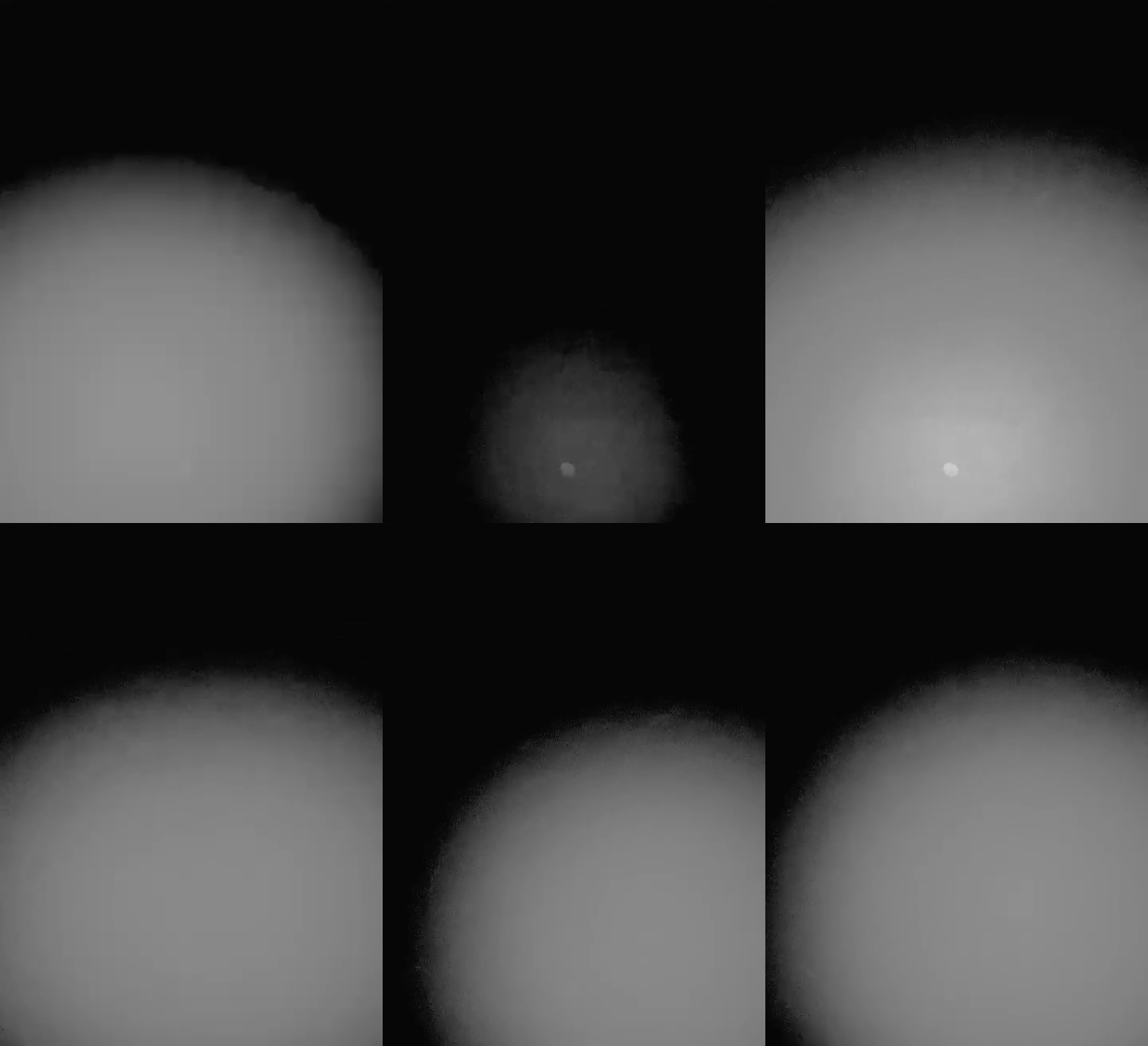
Initially, I attempted to extract a Morse code message, intrigued by the possibility of hidden meaning within the video. The resulting letters, however, were entirely random. This outcome indicated that my initial approach had been overly elaborate and that the phenomena under study were inherently simpler – What is absent in the video? – Sound.
A new idea came to my mind.
Table 1 presents the timing of flashes over the 57 second duration of the video. This served as preparation for the next step, translating the intensity of light into chords (Table 2).

Using a table of recorded flashes, I developed a system to translate light impulses into musical chords, where each flash in the video becomes a coded symbol, interpreted through principles of intensity, duration, and rhythm. Each flash is interpreted as a unit of language. The number of consecutive flashes determines the corresponding letter (1 flash = A, 2 = B, and so on). The resulting sequence of letters is then musically interpreted as a sequence of chords, each chord corresponds to a letter (e.g., A = A minor, B = B minor, etc.). Also, each flash is considered as a sonic impulse, with its duration and tonality assigned according to its visual characteristics (intensity, length, and rhythm). Within the video, eleven key moments were identified.
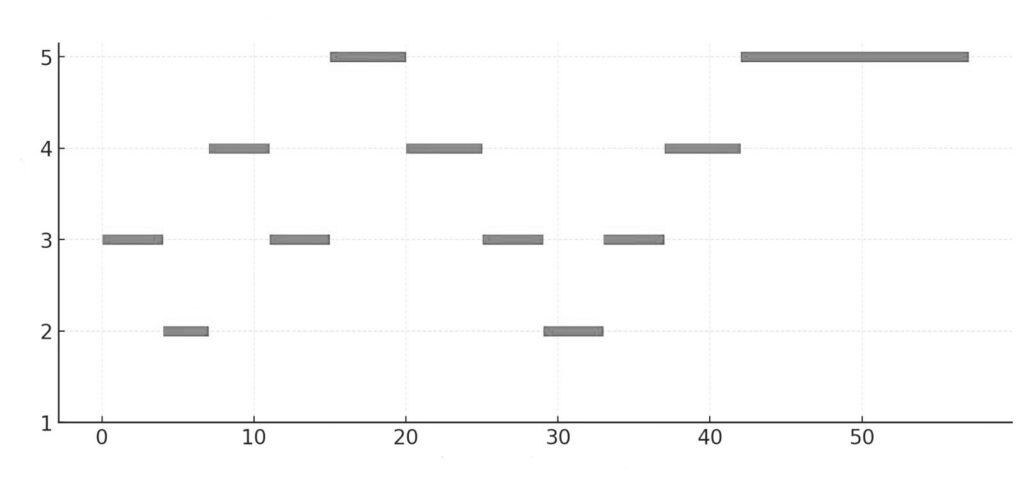
This table formed the basis for the construction of chords, which were systematically formed by adding the flashes together.
What, then, is Utopia? It is not conceived as an escape from reality, but rather as an intervention within it. Accordingly, the sound in Tomljenović’s video is not external or imposed, it emerges as a direct product of the video itself. The coded flashes reshape an already existing system, giving rise to an altered regime of perception.

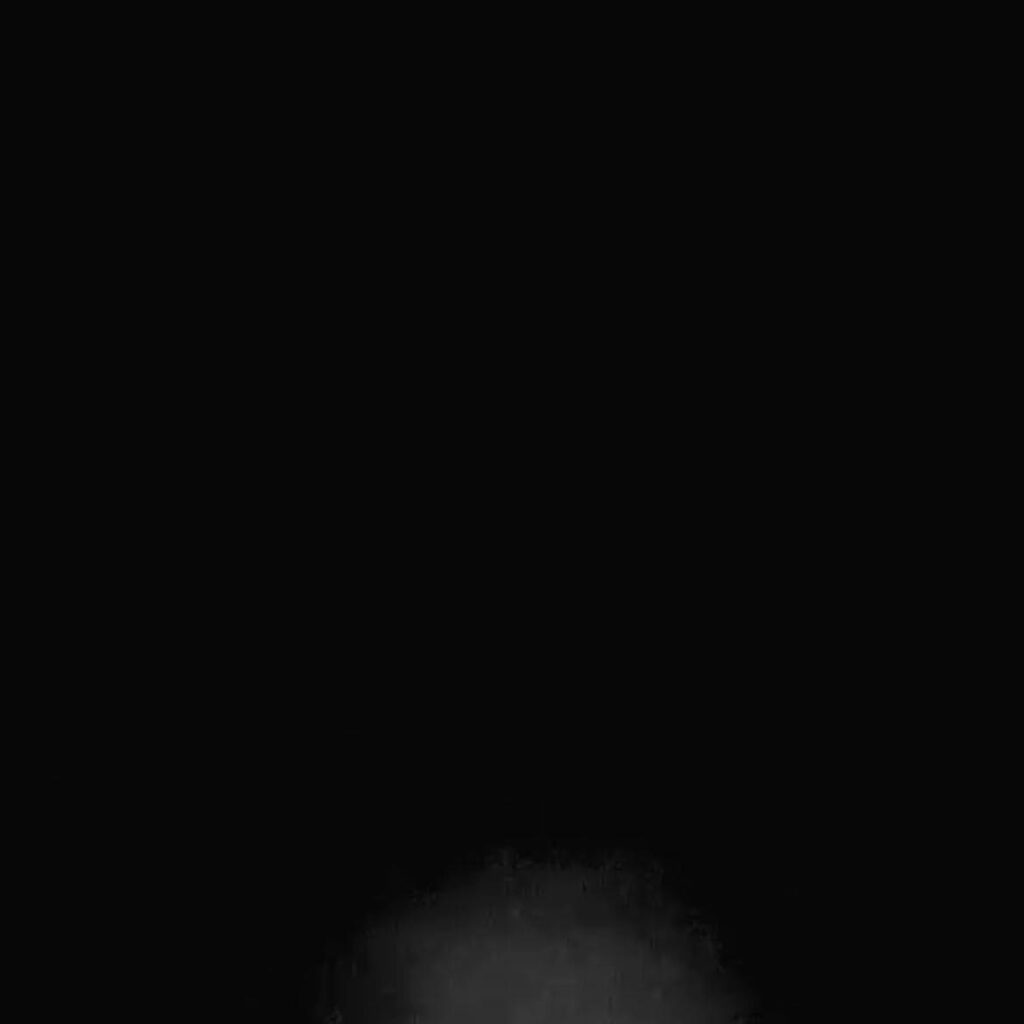

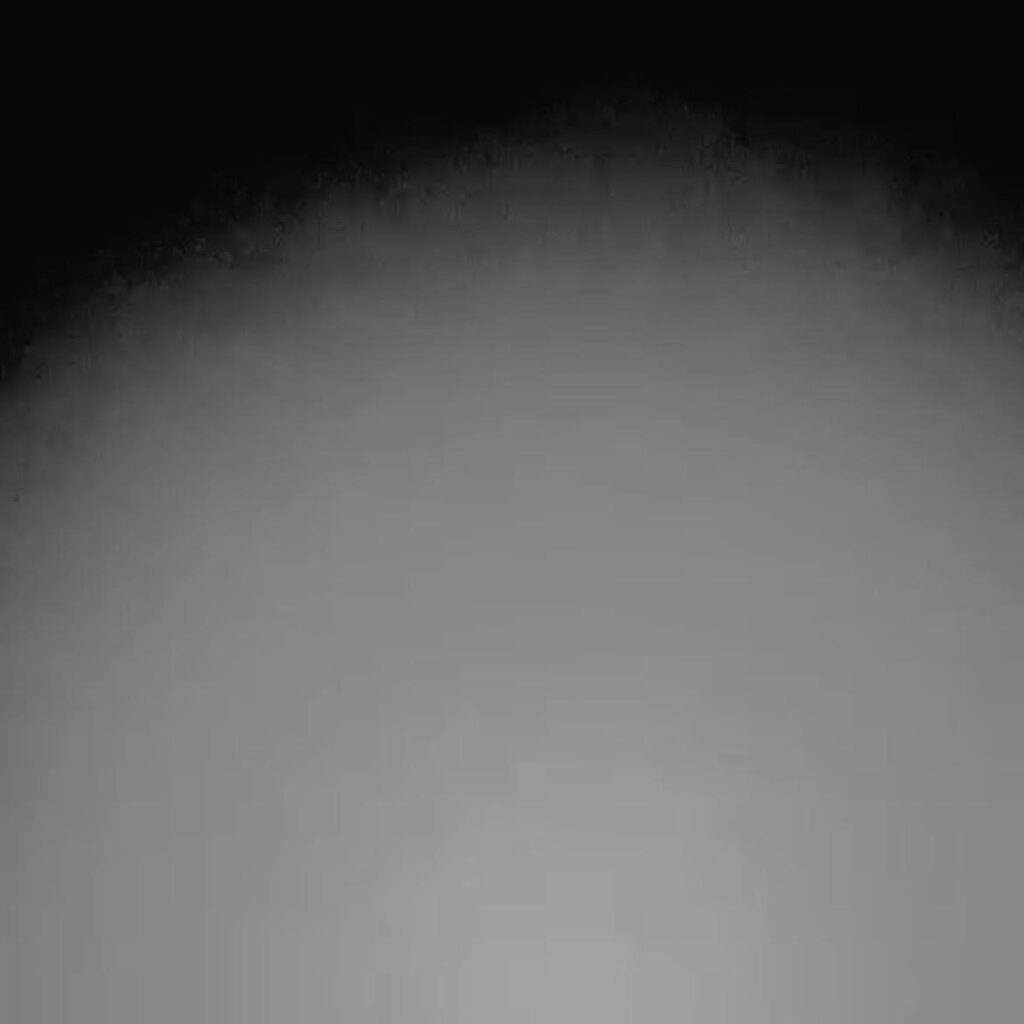
These photographs show the appearance of a single flash. I carefully selected and observed eleven key moments in this way. The chords in the following passage are made according to this method.
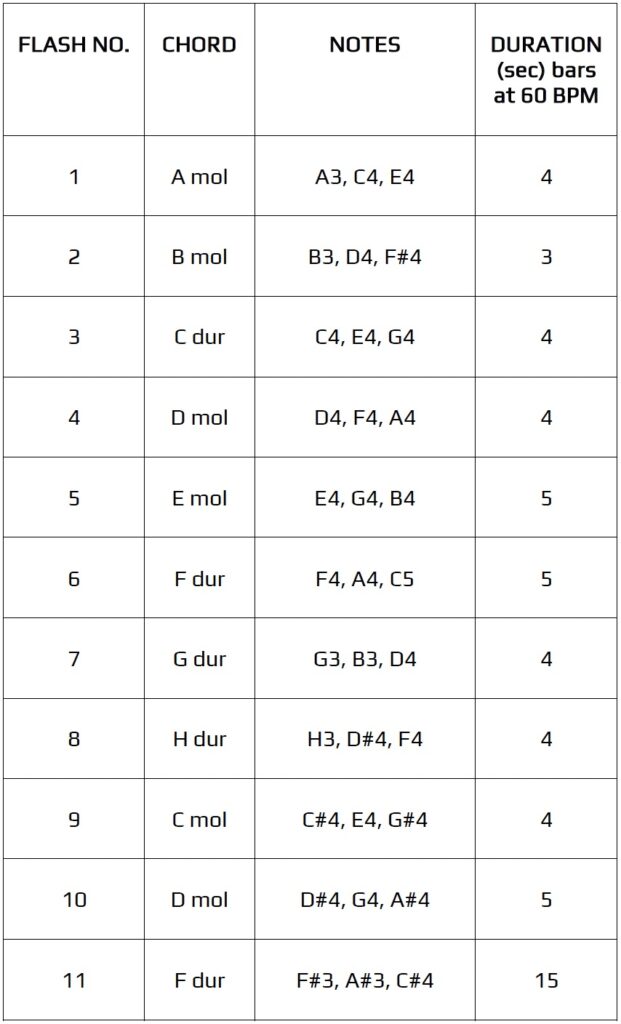
My colleague, Marija Zorić, offered to arrange the resulting chords into a piano composition and verified my chords. Methodologically, the work is based on a system of coding, each letter is linked to a chord, with its duration reflecting the length and intensity of the light. This process creates a musical structure derived directly from the video. In this way, the video becomes the score, and the sound its interpretation.
The sound follows the video, though not necessarily in the way one might expect. The score was simply overlaid onto the video without elaborate intervention, precisely because Ivana’s video itself is simple, intimate, and sincere.
The work departs from the most elementary component of Ivana’s experimental film: the flashes of light, which I do not regard merely as aesthetic elements. I interpret them in two ways, through a coded structure and through a harmonic structure. Through this dual approach, the work operates both as a code, a message, and as a composition.
The resulting sound alters the atmosphere of the video. It introduces a narrative line, one no longer simply watches what happens, but listens to how it unfolds. The emotional tone of the video also shifts, although nothing external has been added, only what was latent has been revealed.
At the end of the video, the final chord is repeated twice rather than once. This is not a mistake. Within the strict structure of the system, the repeated chord functions as a moment of intervention, a slowing down of the ending.
My approach is inspired by Richard Noble’s understanding of speculative modeling, in which art does not serve as an illustration of the existing, but as a model for imagining alternative regimes of perception. In this sense, my work is not merely data analysis, but a utopian gesture, transforming an everyday, fleeting signal into a structure that can be listened to, performed, and analyzed.
Underlying the work is the conceptual practice of Dan Graham, whose classification systems (Homes for America) structure reality through simple signs. My system of flashes and chords adopts this logic but directs it toward the sensory sphere, where hearing and sight act together and measurement becomes sensation. The “error” at the end of the video demonstrates that no matter how precise a system may be, it cannot be entirely controlled.
Art begins when the system stops.
Concept & Chords: Tonka Sušec
Piano & Composition: Marija Zorić
Original Video: Ivana Tomljenović