🕳️ Ecologies of absence: Everyone should be feminists
Editorial note: This work has been created in the context of the Bauhaus Open Studios programme by students from the Academy of Fine Arts in Zagreb (studio leads: Nikola Bojić, Ivan Skvrce, Marko Tadić) in October 2025. Engaging with selected objects from the collection of the Museum of Contemporary Art in Zagreb (MSU)—textile fragments by Otti Berger, Ivana Tomljenović’s experimental film, and the correspondence of Marie-Luise Betlheim and Lou Scheper—the student research group explored not only what is present and preserved, but also what is absent and lost. They ask whether fragments can become active models for learning, and whether forms such as friendships, memories, and gestures of care can guide us in thinking about ecology, responsibility, and shared futures. Collections thus are not static repositories, but learning environments—ecologies in which human and non-human, personal and collective, past and present, remain fragmented and incomplete, yet living and entangled.


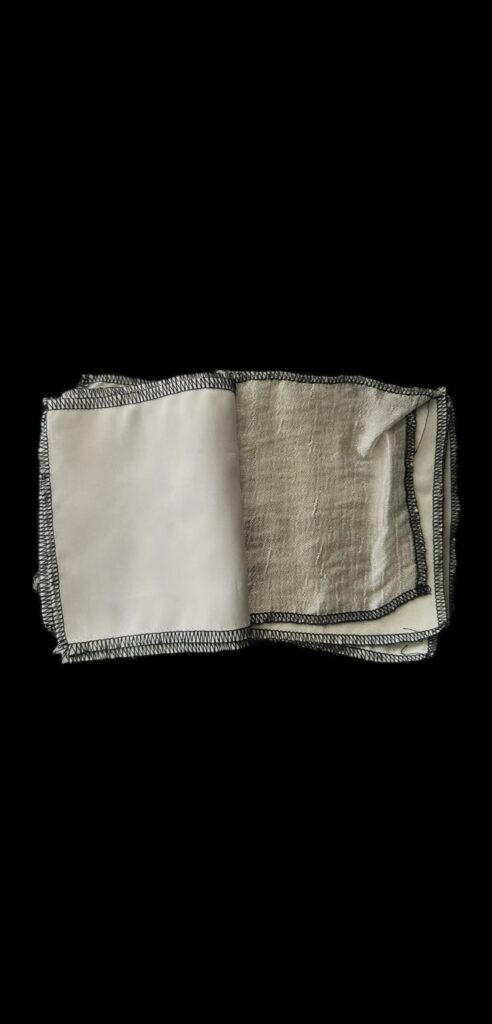
The artist Book “Everyone Should Be Feminists” was created as a result of my research into the work of Otti Berger, specifically her textile coverlet from the collection of the Museum of Contemporary Art in Zagreb. The piece explores two intertwined themes: feminism and absence. Both themes naturally emerge from Berger’s artistic practice and are essential for a deeper understanding of the Bauhaus movement itself.
Otti Berger was one of the few women who not only studied at the Bauhaus but also became a professor there. She carved out a position for herself that was, at the time, largely reserved for men. Despite the progressive ideals often associated with the Bauhaus, the institution still adhered to many conventional gender norms. Women were frequently pushed into secondary roles and denied the opportunity to fully develop their potential. This artist book aims to celebrate all the women connected to the Bauhaus—students, artists, and educators—who have historically been overlooked. It seeks to symbolically restore their presence and significance.

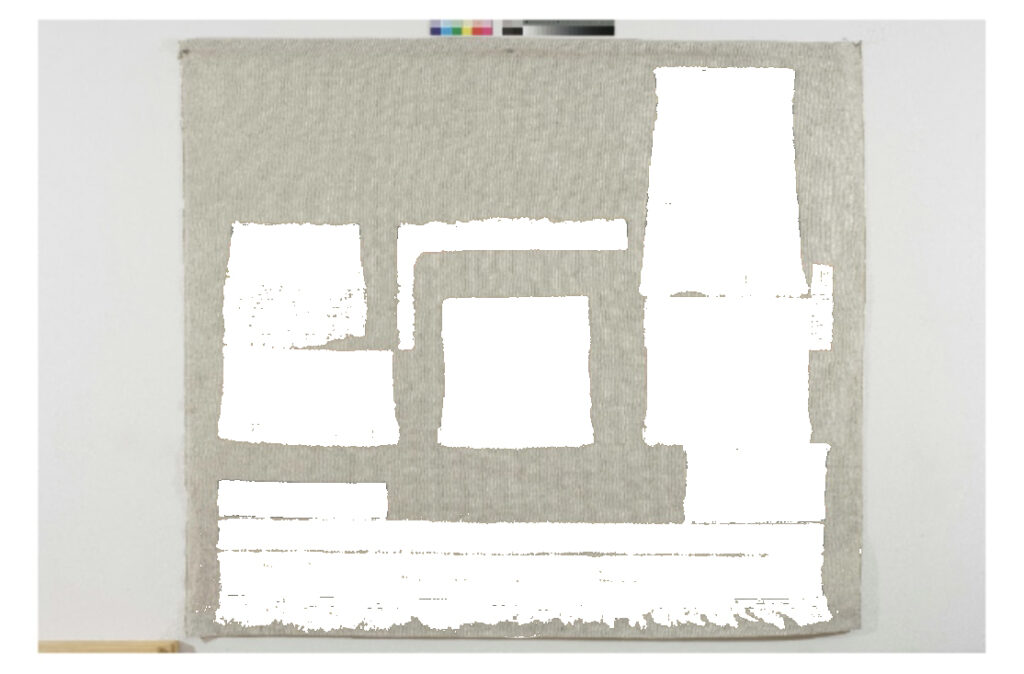

The second theme—absence or emptiness—is directly tied to the original textile cover, but also strongly echoes the feminist narrative. In this work, the concept of absence is represented through fragments of woven fabric, randomly stitched onto the book, referencing Berger’s technique. These “voids” become symbolic spaces that are now filled by the forgotten or ignored women of the Bauhaus—turning absence into presence, negative into positive.
Unlike conventional artist books, this one contains no text or written language, but it still tells a powerful story. Instead of paper, the pages are made from randomly assembled pieces of fabric taken from my mother’s sewing studio—an homage to the improvisational stitched Berger’s textile designs. Each page features an open space, or “hole,” mimicking the pattern of the original cover. These voids are symbolic of the women of the Bauhaus, whose presence was often invisible.
Inside every empty space, there is a single thread. When the book is closed, these threads intersect to create a web—a metaphor for the connections, friendships, and networks that Bauhaus women formed with one another during their time at the school. This artist book becomes not only a tribute to their resilience and creativity but also a fabric of memory, reclaiming their rightful place in art history.

