Electronic Music at the National Institute of Design
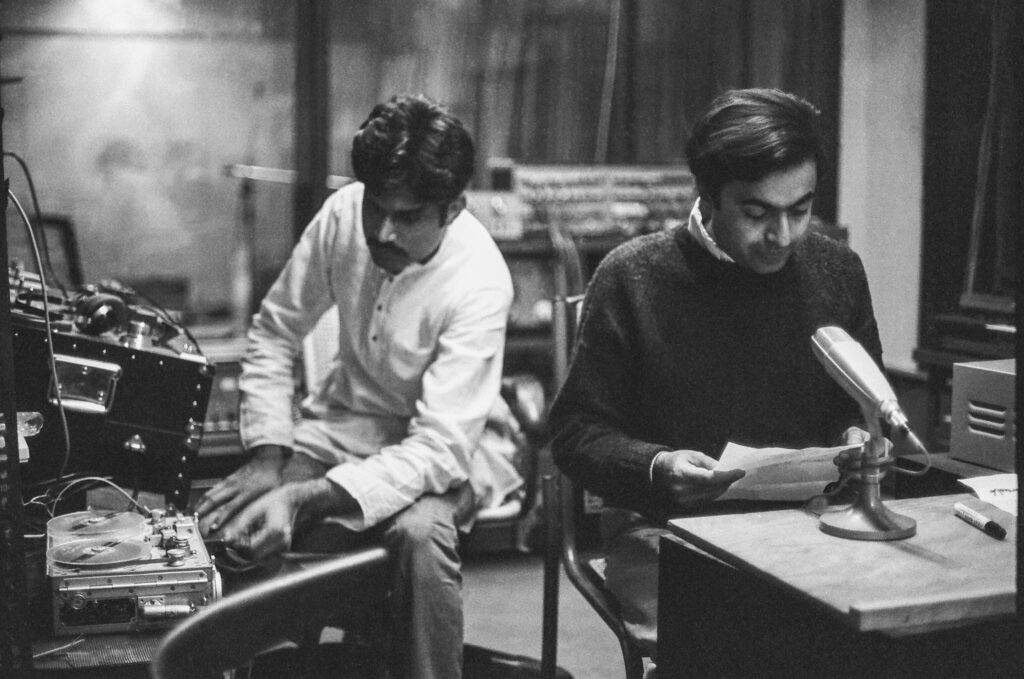
Founded in Ahmedabad in 1961, the National Institute of Design (NID) formed India’s central outpost for the development of design pedagogy post-Independence, creating an intersection of philosophies and teaching practises that incorporated elements of the Bauhaus and Montessori methods with the principles of Mahatma Gandhi’s ashram and the teachings of Shantiniketan, the eco-conscious school founded by the poet and painter Rabindranath Tagore. The institute, led by the internationally connected Sarabhai family, developed the mantra ‘learning to know and learning to do’, a variation of the dictum ‘learning by doing’ oftentimes associated with the Bauhaus—an indicator of the influence of modernist ideals on the prospective blueprint of the NID, and a mirroring expressed through an ongoing collaborative history between the NID and the Hochschule für Gestaltung Ulm across the 1960s.
The NID’s programme aimed to create a new generation of designers to shape the emerging nation of India, transitioning the country from traditional crafts practises towards industrialised manufacturing and production, with a focus on new innovations in technology and media. It was within a multidisciplinary ethos that in 1964 the Sarbhais set out to locate sound and music within a dialogue with the institute’s wide-reaching educational ambitions. After financial seed funding from the Ford Foundation, the NID assembled a collection of tape recorders and microphones to initiate a basic configuration for a sound studio. The new facility was overseen by Gita Sarabhai, who had previously studied in New York with John Cage. She developed a soundtrack for India’s pavilion at the 1967 Montreal Expo, as well as amassing an extensive collection of field recordings from the surrounding region of Gujarat. This initial foundation was augmented in the autumn of 1969 with the support of the New York composer David Tudor, who oversaw the acquisition and installation of a Moog modular synthesizer, Tannoy sound system and several Ampex tape machines, bringing the facility into its second iteration as an electronic music studio, one of the only global examples of such an enterprise being initiated inside a design school.

Conceived as an adjunct to the film and animation department, the studio created a platform for free-thinking explorations of musical composition, tape experiments and sound design over a three-year lifespan. The output of the studio and the five Indian composers working there—Gita Sarabhai, S.C. Sharma, Atul Desai, Jinraj Joshipura and I.S. Mathur—is documented through a collection of reel-to-reel tape recordings chronicling the years from Tudor’s arrival in 1969 to the recording of the final composition in the autumn of 1972. Despite its short lifespan, the studio’s archive demonstrates a diverse array of aesthetic and structural approaches to sound, including tape collages, soundtracks, radio adverts, field recordings, electronic improvisations inspired by classical rhythmic talas, spoken word and phonetic experiments, and effects processing of traditional Indian instruments such as the tanpura and tabla. The tapes outline the unique conditions of the NID and the aspiration to locate the sonic within India’s post-colonial programme for design pedagogy and national development, offering an insight into the exploratory iterations of modernism being cultivated in the subcontinent during the utopian era of the 1960s.
is a London-based artist and musician, working with sound, performance and installation. His recent research has focussed on the development of India’s first electronic music studio and its dialogue with Modernism’s evolution within South Asia.