I love you in the name of the commons


Imagining an art institution as a tree allows us to think of growth in a different way than what colonial capitalism compelled us to do, namely in terms of expansion, extraction, exploitation and profits. The so-called edifice complex is coupled with museums that, as a meme says, ‘are designed to preserve the inert and exclude the living’. Even though the (art) objects in museums are not as inert as we think and the simple binary of the dead in contrast to the living may no longer be valid, most museum protocols point at the opposite. What would an art museum be like if it were a tree?
It would be part of a forest of small to mid-size art institutions that sprung up in the 1990s across the globe – that is ‘in the era of globalization’ – unlike the 19th-century bourgeois or state model art institutions like museums with collections. The Casco Art Institute has been growing for 33 years now. First it was meant to fill a gap and be a public platform for presenting works by artists from the city of Utrecht and elsewhere in the Netherlands. After about five years it evolved into treating its space as a multi-functional studio for research, experimentation, production, discussion and presentation while going out into the ‘public’ space and working with artists from other parts of Europe.
This made Casco be known as Casco Projects, as the domain of the Casco website was called at the time when the Internet became part of everyday life. The director at that time, Lisette Smits, told me once that Deschooling Society (1971) by Ivan Illich was her bible for directing the institution, which actually has to do with deinstitutionalisation of both art and education or even beyond that of living and being.
The following directors, Emily Pethick and myself, did not digress from that but joined the pursuit of this cause with different strategies, methods and practices. As a strategic move to articulate its position within the Dutch contemporary art and cultural landscape, the Casco team and board added a new subtitle to Casco, calling it Casco, Office for Art, Design and Theory. During the time of receiving this name, Casco enhanced the focus on an interdisciplinary and participatory approach in art practice. The languages of graphic or architectural design were tested, and their experimental forms offered a support structure as well as spatial or literary expression to what Casco and artists do.
The following phase up until now has been marked by another change in the institution’s name into Casco Art Institute: Working for the Commons. Guided by the process of researching the notion of the commons and how art is related to that with a number of artists, local students and neighbours, the Casco team and artist Annette Krauss took on the process of unlearning Casco’s way of working in order to shape its relationship with the commons.
This process coincided with Casco engaging with the self-transformative process of the Arts Collaboratory network consisting of similar kinds of art institutions, which, however, were located in the so-called Global South, and soon after that with the agro-ecological history of Leidsche Rijn, a newly urbanised area of Utrecht with the Outsiders collective. In other words, the institution’s own journey of decolonising its scope and mode of working slowly led it to be open, wide and rich in its relationality with ‘others’ or rather ‘one another’ as you move away from assuming the world is organised around the principle of ‘us versus the others’ but within the forest of the minor art institutions, as one could say.
Recently Casco made a public announcement about its ‘ecosystemic shift’, which suggests a new mode of governance and economy in a commoning institution. We are going to see how this will evolve again, especially as our ecosystem at large on a planetary level is going through the drastic if not catastrophic change.

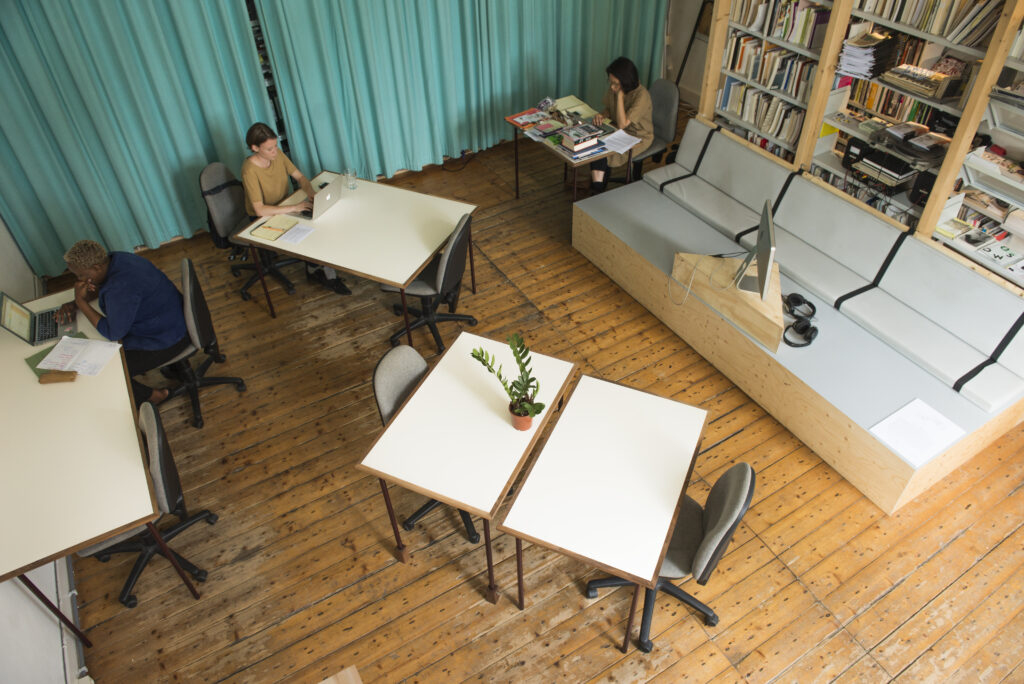
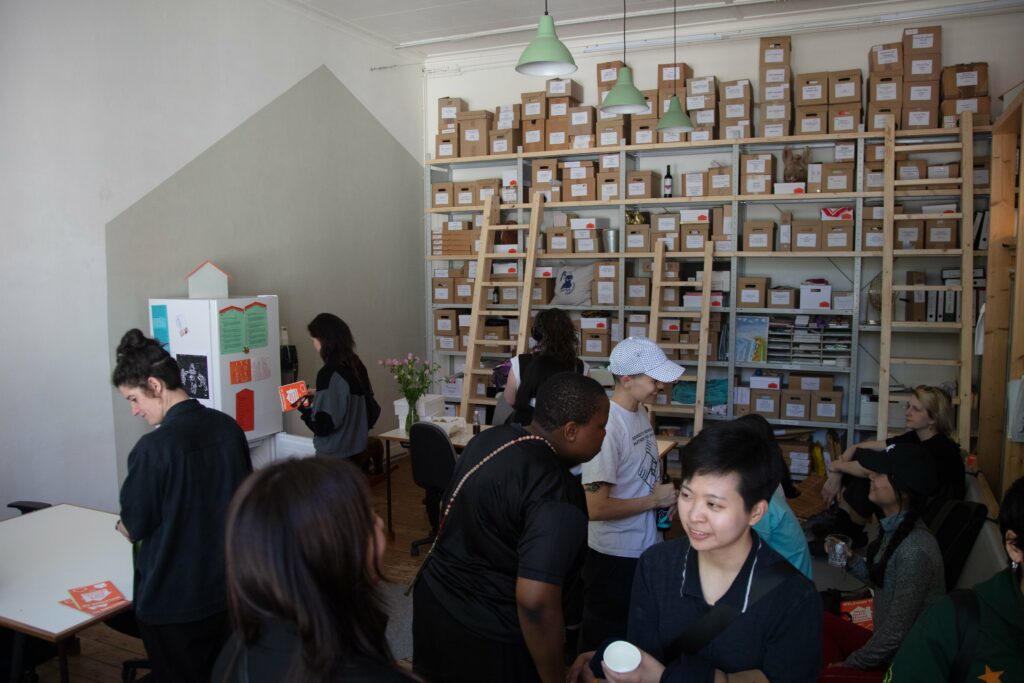
While there can be no commons without a community that takes care of and benefits from the commons together, this does not mean there has to be a collective or collectivity in all aspects and all the time. In fact, in shifting to Casco Art Institute: Working for the Commons – from a mode of representing to a mode of practicing and sharing the commons – more attention was given to each individual in the team as symbolised by the replacement of a big collective office table by several individually customized desks in different sizes.
In a hierarchal structure governed by the public or private rule, power is centred on a few selected individuals in management and the rest of the team are subjected to the decisions made by them and somehow remain replaceable as per their functions. As a team making a transition from a public or private body to the commons, that meant for us that each person is ensured of her, his or their own subjectivity as a practitioner of the commons, and we hold on to an awareness and responsible acts that imply we are taking care of the institution together.
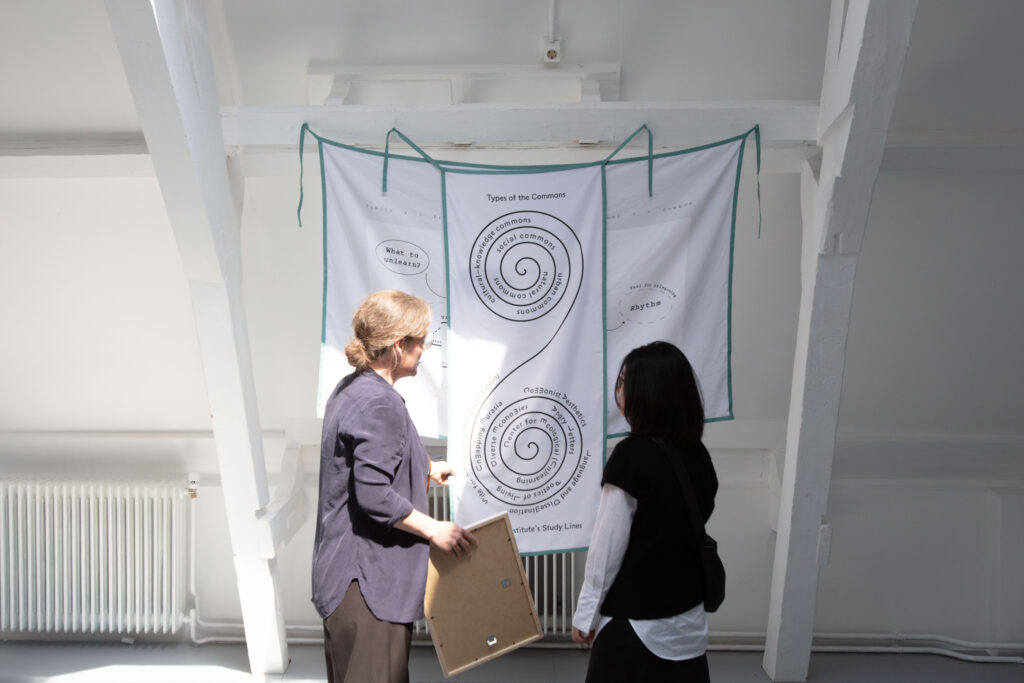
This assurance was made through how each person feels connected and committed to what we called study lines, each of which includes a wider community of shared concerns. The notion of study was inspired by Fred Moten and Stephano Harney[1] as a way of learning and living by acting and planning together in resistance to oppression, indebted to the anti-slavery struggles, and if possible with the sense of prophecy of what to come. The “study lines” refers to the key areas of commoning in our own terms.
The team indeed has been changing in this regard, and it’s important that no team remains the same, and this aspect of individual transformation along with a collective transformation has to extend beyond the team, involving collaborators and co-learners while the boundary between the team and the ecosystem dissolves, facilitating movement and on-going reconfiguration in the ecosystem. In the commons, I believe, everyone has to be a leader who knows which person or thing should take their turn of leadership and who knows how and when to act as an assistant. This goes against the undiscriminating idea of a flat horizontal hierarchy.
Of course there is already a deep sense of caution of a mob when different scales of the commons are imagined, let alone gated communities and other enclosures. Still, we need to see stars, be stars, and stars are together and far away to make up the universe. Last but not least, at the same time, the precondition for this kind of leadership should be that it has its foot down on earth, for which ‘cleaning’ could stand as a synecdoche.
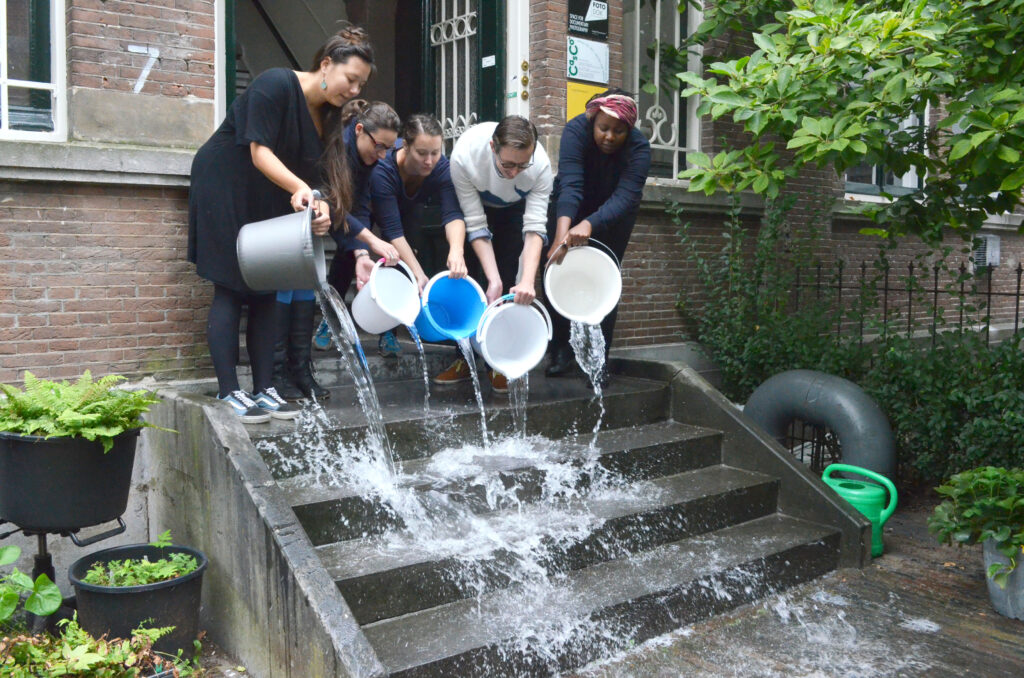
Cleaning our office together is one of many exercises that the Casco team and Annette Krauss tried as a strategy of unlearning our anxiety-driven busyness, which stems from our habitual desire for productivity and expanding, competitive business. While some exercises like ‘reading together’, ‘mood colour’ or ‘property relations’[2] were tried once, others, like cleaning, have been made into the ritual and habit. It is significant in many ways.
One is the recognition of perpetual inequality in gender and race as we can see those originating from the former colonies come and clean homes and offices in the countries of the colonizers. In the developed world, still many more women or especially women of colour than any men babysit and cook for children, especially away from their own home. This has to do with how coloniality persists in the modality of capitalism and how it perpetuates to undervalue the realm of reproductive labour or rather depends on its being cheap or free labour, all the while separating the productive and the reproductive, and making the latter invisible. This can be seen in the self-(re)producing natural ecosystem as well. The labour of nature is completely ignored. Nature is only seen as a source for exploitation and extraction which has been leading our time to being an era of mass extinction.
In the way the question ‘Who cleans the world?’ led Françoise Verges[3] to examine decolonial feminist struggles in critiquing white-women-centred feminism, the act of cleaning together led us to examine different domains of reproductive labour and to seek the possibility of undoing the separation of production and reproduction. Faisol Iskandar, a leader of the migrant domestic workers’ movement in the Netherlands, has told us and above all showed us how cleaning defines what leadership should be about. It’s not about resting in an armchair while someone else is cleaning for you. It is cleaning, cooking, taking care of people to support life in your community and wider ecosystem.
‘The commons provide services which are often taken for granted by their users: those who benefit from the commons do not take into account their intrinsic value, only acknowledging it once the commons are destroyed and substitutes need to be found. To some extent, the universal services provided by the commons are similar to household work, never noticed when the work is being done. Only when no one is there to do the dishes, you notice its value.
In other words you don’t miss something until it is gone. Two striking examples of this feature are represented by mangroves and by coral barriers: people living on the coasts are not able to estimate the value of the services they provide simply because they don’t even know that these goods have a specific function, that they are doing something for them. Only when a Tsunami hits, destroying villages, the value of such vegetation becomes apparent. However, prior to their destruction, mangroves played a major role in protecting coastal villages from tsunami waves. It would be highly expensive to build a similar barrier artificially.’[4]
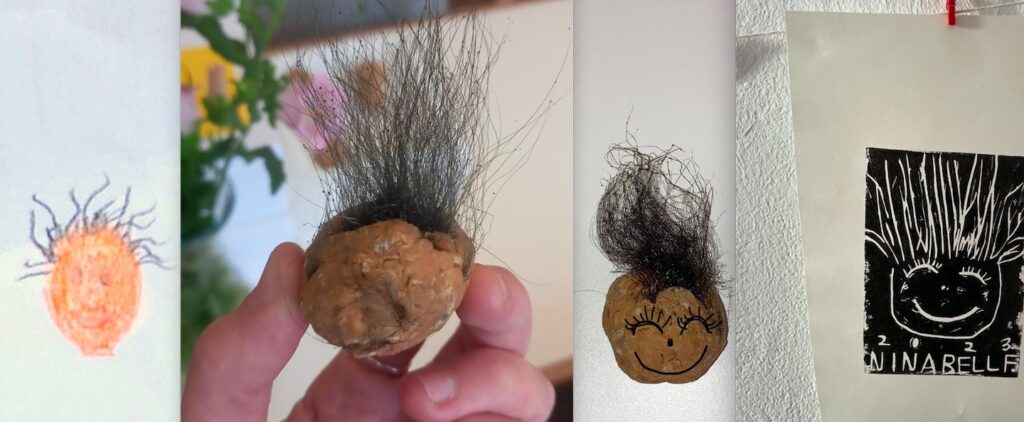
The figure of Nina bell F. was conceived around 2016 by former team members, artists and cultural practitioners at Casco Art Institute out of a shared concern to care for and maintain the ongoing practice of commoning and to unlearn current practices with the aid of art beyond oppressive institutional boundaries and habits. Their/her name conjures up the artistic, Black, feminist and political engagements of Nina Simone, bell hooks and Silvia Federici. As Nina continues to live, the practices of many others are called upon, keeping her/them as a collective figuration that transcends individual personhood and institution/organization as well as the ordinary divisions of artwork, labour and life.
The House Museum was created to manifest the embodiment of Nina, offering the public a way to recognize and possibly be part of Nina. The Nina bell F. House Museum collects and shares ephemera, left-over objects, notes, snapshots, among other (accidental yet telling) things unearthed from the archives of the Casco Art Institute’s exhibitions, projects and collaborations each of which tells the story of Nina.
It foregrounds the non-conventional practices of archiving at the heart of small institutions which often remain invisible, undervalued and overlooked due to the culture of visibility and the accelerative and extractive modus operandi prevailing in our time. Simultaneously, the House Museum works at odds with other institutionalized archival practices that tend to hoard, guard and stall archives by insisting on forms of openness, vitality and deliberation where the collection is made accessible for use, contribution, co-creation, exchange and circulation over time.
The museum itself may be small, but it is potentially ubiquitous, looking static but keeps on breeding different beings who find a way of living together and transforming together. A series of small ‘fermentation houses’ as the House Museum’s architecture were provided by Amsterdam-based artist Donghwan Kam, they indicate that the dwelling place of Nina exists beyond the visible and physical realm while sheltering and making a new alchemy to be collectively tasted.
is a curator, writer and organizer. She’s currently the curator of the Hawai‘i Triennial 2025. From 2008 to 2023, she served as the director of the Casco Art Institute: Working for the Commons in Utrecht, the Netherlands. Under her directorship, Casco has been exploring the commons as an alternative to binary worldviews and systems through and for art, taking that view as their organizing guideline. Her key curatorial-collaborative projects at Casco include Grand Domestic Revolution (2009–2012), Site for Unlearning (Art Organization) (2014–2018), Travelling Farm Museum of Forgotten Skills (2018–ongoing) alongside engagement with networks like Arts Collaboratory and Cluster. Choi served as artistic co-director of the Singapore Biennale 2022, Natasha, and she was the curator for the 11th Gwangju Biennale, titled The Eighth Climate (What does art do?). As a member of Academy of the Arts of the World in Cologne, Germany, she curated the exhibition project Gwangju Lessons (2020), which travelled to the Asia Culture Center in Gwangju, South Korea. Choi is also a member of the faculty of the Dutch Art Institute and an advisor for Afield, which calls itself ‘an international network of cultural changemakers’.