Preface: Progressive learning communities as an ongoing experiment
The search for new communities, for ways of living and working together, is experiencing a revival. Especially in times of crisis, people long more than ever for collective forms of living, learning and working, for an alternative way of organising life – in the present day just as in the 1920s.
Collective action builds belief in new ways of life and models of society and gives rise to new spheres of action and thought. Commoning, a living process also defined as community building, has influenced the emergence of new communities in the 20th century and beyond. In community-based economic systems, communal gardens or alternative housing and education projects, people focused not only on fulfilling their own needs and jointly managing resources, but also on personal engagement and active collaboration, a connection with others.
At the same time, commons are not to be regarded primarily as resources or goods but rather as frameworks within social structures and processes. Silke Helfrich and David Bollier describe commons as models that generate satisfaction, which arise ‘from a combination of personality, place, culture, time and political circumstance’. Commons, the authors add, ‘prompt us to see the world from a fresh perspective and to fundamentally acknowledge that a self emerges from relationships and can only exist in and as a result of them. These “we‘s” are more than a sum of individuals. They come about in real and virtual encounters and in joint action.’[1]
Our society, the largest community we live in, is in and of itself unstable. Anything is possible, anything can change from one moment to the next. Covid-19, climate change, war, crises, personal freedoms, shared responsibilities – there was and is a huge amount to negotiate. The new communities are taking shape in the field of tension arising between open and closed, urban and rural, young and old, east and west, north and south. In this context, social inequality is driving us far apart, not only spatially, but also in terms of our experiences. We increasingly see the world from completely different perspectives and appear to be unwilling to engage with the other side. Especially in light of the diversity of the emergent digital communities, the question arises of how open we really are to different views or backgrounds and even whether we are merely operating in separate echo chambers, in which everyone agrees on the same things. Is commoning deteriorating here into an utterly naïve kind of wishful thinking, or is it perhaps even contributing to the romanticisation of present-day problems?
The content of the third edition of the e-journal in the digital atlas Schools of Departure is devoted to the diverse forms and dynamics of new communities in the field of design education. Learning communities focused on educational reform emerged in the early 20th century as a response to the inadequacy of traditional teaching methods given the challenges of the modern age and strove to completely overhaul both academic education and vocational training. This issue examines not only a range of historic case studies, but also contemporary approaches to creating alternative learning environments in art, architecture and design.
How can new learning communities become successful, or what causes them to fail? The case of the historic Bauhaus sheds light on a central factor. These new communities are in most cases temporary projects. Collective ways of working are put to the test in the field of tension that exists between individual and collective creativity. When a new community is formed, its members mostly pursue a central idea, a concept and manifesto or at least a specific question. Ideally, theory and practice reinforce each other. The question, ‘How do we wish to live together and learn from each other now and in the future?’ is accompanied by a practical commitment, namely, ‘Who does not only think about the future, but is already trying out new things here, now?’
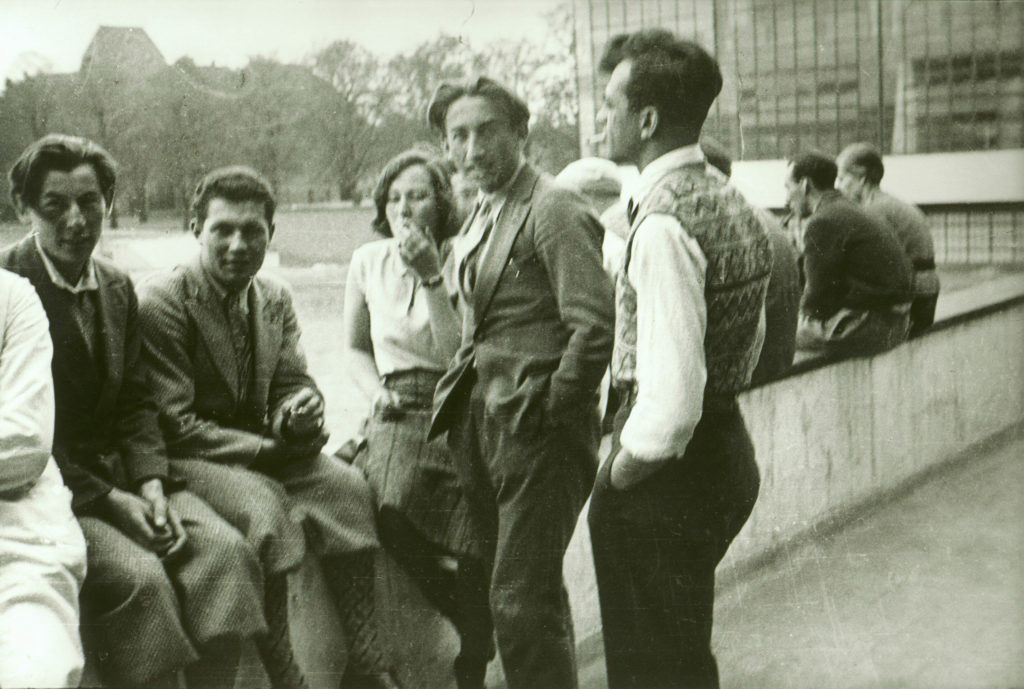
At the historic Bauhaus as a community of people living, learning and working together, these questions manifested themselves in the ambition of building for a new society. The workshops as a framework for training and production, the collaboration between the different disciplines and training levels, and the social connections between the members gave shape for a limited time to a polymorphous learning community. The existence and strength of the collective was rooted in key factors including an expedient infrastructure, tried and tested practices, rituals and celebrations, as well as a sense of belonging and a spirit of social cohesion.
Who feels like they belong, and who belongs to the community? Essentially, there have always been people ‘inside’ and others ‘outside’, meaning that ‘belonging’ both includes and excludes people. The reasons for the failure of a learning community sometimes lie here, to which aspects such as the social climate, political pressure, fear of the new, hierarchies or financial dependency may be added too. The historic and contemporary case studies portrayed in the journal show the diversity of possible experiments, not so much as a recipe for a successful development of communities but rather as a testing ground for possible experimental orders.
In his essay, Greg Castillo introduces a course for architecture students at Berkeley University in 1970/71 which was committed to the countercultural agenda and was called ‘Making a Place in the Country’, also known as the Outlaw Builder Studio. Castillo sees this as a critique of work practices in the professions of design and architecture and as an attack by the counterculture movement on the traditional form of architectural education. On this course, students and volunteers were invited to live and build on a forested hill north of San Fransisco. In the Outlaw Builder Studio, new forms of environmental analysis were combined with artisanal building methods and ethical questions of landscape conservation.
Based on the installation To Trees and Birds, Aleksandra Kędziorek presents the pedagogue Oskar Hansen and his endeavours to overcome the dictates of the closed form. Hansen, a professor at the Warsaw Fine Arts Academy from 1952 to 1983, instrumentalised his theory of Open Form to work against fully defined, dominant spaces. In the installation discussed here, he transformed a courtyard at the university into a backdrop for events. Throughout his life, Hansen focused on the development of non-hierarchical, absorbent spaces, on spaces for individual expression and on the integration and involvement of users in the design process.
Andrés Garcés Alzamora describes the Chilean school project Ciudad Abierta (Open City) as a poetic triad (life, work, study). Originating as an idea at the Universidad Politécnica de Cataluña, from the mid-1950s poets, architects and artists wrote the manifesto of the Open City Amereida (a composite of the words America and Eneida, Spanish for Aeneid) and on this basis established a place in which poetry and craftsmanship came together, a school in which poetry still has a place in the collective today.
The pedagogical experiments of Ant Farm in 1971 introduced by Lee Stickels in the journal likewise aspire to reshape architectural education through means of radical, alternative ways of living. In keeping with the ideals of the time, Ant Farm advocated the concept of learning as a ‘continuous lifelong process’ and the need to break away from traditional educational and professional institutions, spaces and modalities. Architectural teaching was to undergo radically reform, becoming an expanded sphere for situation-based learning incorporating happenings on the beach and other experiments in ‘the art of life’ according to their philosophy: ‘Everything in daily life must become magical.’
For Heidi Gruner, the legendary Black Mountain campus in North Carolina is equally ‘magical’. In the summer courses she initiated in 2016 in the School of the Alternative, the focus is on collective organisation, solid structures, community practices, methods of human conflict resolution, a radical world design and care of the community. Once a year, with her team she tries to create an ephemeral model of the world that everyone involved dreams of, without hoarding resources or gatekeeping knowledge.
The curator Binna Choi has been directed and guided collective transformative process at the international Casco Art Institute in Utrecht. Under the additional title ‘Working for the Commons’, in recent years the institute has increasingly focused on the practicing and sharing of common goods and on researching commons and their connections with art. To consistently ‘unlearn’ Casco’s working methods in order to shape the relationship to commons is absolutely essential, not only for the institute’s longstanding director, Binna Choi. In her article she focuses on the transformation process of this learning community, which has grown over the past 33 years and continues to evolve from a representational platform to a self-unlearning ecosystem for the art of commoning.
For Fernando Garcia Dory, unlearning the familiar, recognising the old and learning from the worldviews of smallholders and indigenous peoples, thus becoming open to new worlds of imagination, has become not only a creative exercise, but also a question of survival. Following his three-year experience at the Casco Art Institute, in 2009 he founded the agency Inland, which serves as a platform for diverse actors in agricultural, social and cultural production. The Inland project mobilises teams of artists in order to learn from rural communities and to lead a way of life that is connected to the land. They activate the rural environment with artistic tools such as mobile kitchens, radio stations or microarchitectures of farming. They engage with rural arts and crafts and in the process discover what must be changed at the core of art and design education.
is a research associate at the Academy of the Bauhaus Dessau Foundation, acting as deputy head of the department since 2018. Her work focuses on pedagogy, design and digital mediation. After obtaining a certificate of advanced studies as Digital Curator from Pausanio Academy, Cologne, in 2021, she has been responsible for the digital research project Schools of Departure, an online atlas of design and art education beyond the Bauhaus. Furthermore, since 2020 Katja has been in charge of developing online teaching modules in the context of the international Bauhaus Open Studios programme, which she has been heading since 2015, and the online programme Vorkus Module. From 2005 to 2014, the media, theatre and pedagogy scholar (MA) was an advisor to the director of the Bauhaus Dessau Foundation.