Epilogue: How craft disappeared from the Bauhaus
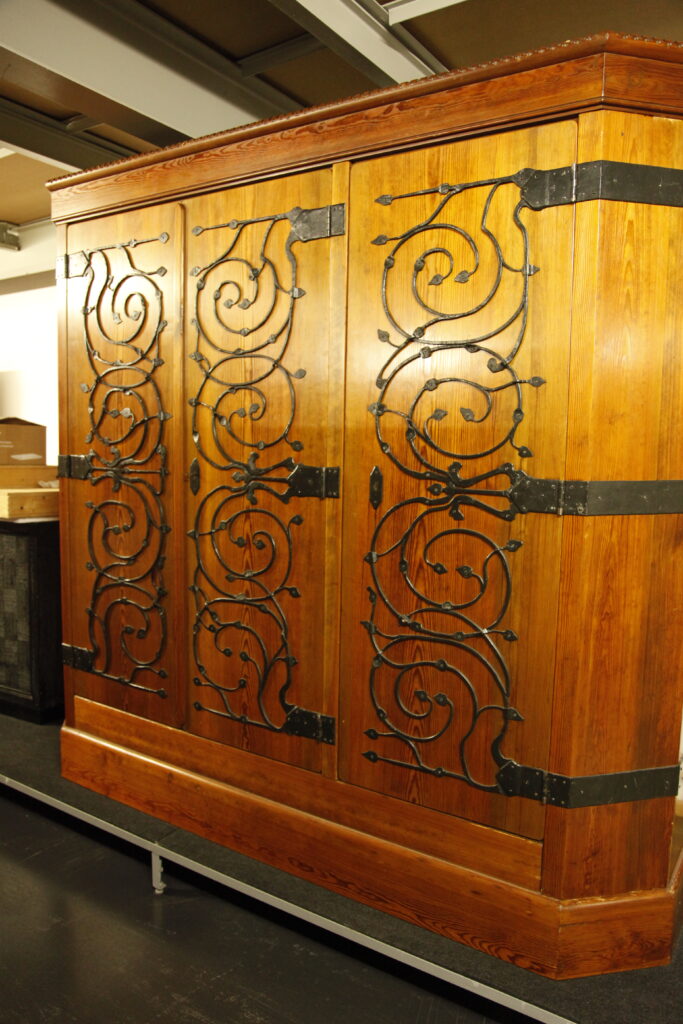
On entering the furniture section of the collection of the Bauhaus Dessau Foundation, one immediately encounters a large cupboard by Richard Riemerschmid of the Deutsche Werkstätten Hellerau (German workshops Hellerau). Right next to it stands another piece from the same era, made in the Wiener Werkstätte (Vienna workshop).
What do these testimonies to the arts and crafts movement stand for in a Bauhaus collection? In his book The new architecture and the Bauhaus (1935), Walter Gropius already put forward a narrative that describes the Bauhaus as the culmination point of a development from the arts and crafts movement and Jugendstil to the applied arts movements and the Deutscher Werkbund (German association of craftspeople). Just a year later, Nikolaus Pevsner took up this narrative pattern and published Pioneers of the modern movement. From William Morris to Walter Gropius with Faber & Faber in London. The two publications thus not only shaped a canon of Bauhaus historiography but, moreover, contributed to a specific positioning of craft in the history of modern design in the 20th century. To what degree Pevsner’s book was inspired by Walter Gropius remains an open question. The list of illustrious guests for the farewell dinner hosted by Walter Gropius at the Trocadero in London in 1937 suggests that they knew each other well.
The art historian Nikolaus Pevsner emigrated from Nazi Germany in 1933 because of his Jewish heritage, despite his sympathies for National Socialism. In Great Britain, Pevsner faced significant challenges while seeking employment in what was for him a new cultural and academic environment. In the first few years, he was supported in Birmingham by a research grant, charged with studying the role of design in British industrial firms. One of his first books, An enquiry into industrial art in England, was published in 1937. We cannot know the extent to which these insights into the connections between the industrial production of objects for everyday use and their aesthetic design motivated him to write a genealogy of modern architecture and design. But this experience doubtlessly stimulated the art historian’s interest in exploring areas unfamiliar to him and, furthermore, to venture to create a historical record of contemporary events. In doing so, he genuinely broke new ground. At this point in time, there existed but a few concise descriptions of the development of architecture, art and craft that connected these in a single line of development. In her research into the origins of the book, Rixt Hoekstra points out: ‘His insights were structured around what could be called a historiographical invention. By positing an unbroken line of development between William Morris and Walter Gropius, Pevsner suggested a unity formed by a central line of evolution between two central figures.’[1]
Although the book was widely criticised for its homogenising and linear narrative and the associated omissions and reductions, in 1947, Philip Johnson, architecture curator of the Museum of Modern Art (MoMA) in New York, approached Pevsner to write a new, revised edition of Pioneers. For MoMA, which had already established itself with numerous exhibitions about modern architecture and now also sought to connect with other art and design disciplines, Pevsner’s interdisciplinary approach was of particular interest. In addition to Pevsner’s many amendments, the title of the book also changed. What initially appears to be a minor intervention in the title of this historiography of the modern movement, according to Irene Sunwoo, turned out to be an unambiguous shift in the historical classification of the modern movement in Europe and its reinterpretation as an American narrative of modernism. With Pioneers of modern design. From William Morris to Walter Gropius, published in 1949, the term ‘design’ had completely replaced the idea of the ‘modern movement’. In addition, the plasticity of the design concept, of its connotations, is also connected with America’s increasing engagement in the field of industrial design. The revised edition of Pevsner’s book was to set out the European prehistory of developments that were continued from the 1940s in the USA.[2]
Edgar Kaufmann, MoMA’s curator of the department of design, thus singled out America’s particular accomplishments in this field with his exhibitions for the Good Design programme (1951–1955). In the context of soft diplomacy, these exhibitions therefore also served to convey internationally the cultural superiority of the USA. A touring MoMA exhibition titled Design today in America and Europe was thus conceived for non-aligned India. A Western understanding of design was now associated with functionality, machine aesthetics and consumer industry. Conversely, an exhibition called Textiles and ornamental arts in India, which opened in New York in 1955, presented the subcontinent as firmly rooted in craft cultures.[3] Was this show an expression of Western exoticism for what the exhibition organisers regarded as India’s intact craft traditions, or did it also call for criticism of the formal minimalism of mid-century modernism and its connectedness with consumer capitalism? Ultimately, the exhibitions were part of a shift away from the narratives of classical modernism, a development to which Pevsner had contributed.
Craft now became a cultural cypher in the search for alternatives to an understanding of design as a formative force and proxy for capitalistic mass consumption. During the heyday of the American studio craft movement, the Asilomar conference of 1957, in which former Bauhaus members Annie Albers and Marguerite Friedlaender-Wildenhain participated, discussed the changed status of craft in the context of modern industrial societies.[4] Annie Albers’s book On weaving (1965) may be interpreted as a contribution to these debates. Against the backdrop of the American way of life and the excesses of consumer society, she focuses attention on the importance of types of knowledge associated with craft and creative means of expression: ‘Our materials come to us already ground and chipped and crushed and powdered and mixed and sliced, so that only the final in the long sequence of operations from matter to product is left to us: we merely toast the bread. No need to get our hands into the dough. … We remove the cellophane wrapping and there it is: the bacon, or the razor blade or the pair of nylons. Modern industry saves us endless labor and drudgery: but, Janus-faced, it also bars us from taking part in the forming of material and leaves idle our sense of touch and with it those formative faculties that are stimulated by it.’[5]
Even during their days at the Bauhaus, Annie Albers and her fellow students wrote texts about their textile practice. In their written reflections on their own craft, they found a way of defining the weaving workshop’s place in the context of workshop production. In the reception of the Bauhaus, these texts have drawn more attention only in recent years.[6] They convey a sense of the areas of tension in which the weavers sought to redefine their profession as textile designers, caught between factory and craft enterprise, between the vocational workshops of applied art schools and laboratories for industrial prototypes, between amateurism and artistic experiment. But as controversial as the ideas and imaginings of craft associated with the Bauhaus Dessau were, they shared a concern about the human capacity for action in the face of the increasingly abstract and intangible conditions under which material goods were being produced, distributed, consumed and used. The question of a ‘new relationship to things’ that was the subject of such trenchant debate at the Bauhaus Dessau led media studies expert T’ai Smith to hypothesise that ‘The Bauhaus has never been modern’. According to Smith, at the Bauhaus Dessau weaving workshop especially as a place where ‘thinking through structures, techniques, materiality” as well as subjects and objects was practised, new relationships to things were cultivated which anticipated the problems of the Anthropocene.[7]
From this perspective, situating craft in Bauhaus history as part of the modern movement, which Pevsner did in his publication, has itself become historic. After all, craft is not a static concept but is itself a historic category against a backdrop of interpretations and connotations that first become visible when its underlying structures become problematic.[8]
Let us release from this narrative framework the umpteen artefacts found in the collection of the Bauhaus Dessau Foundation and which, at the time of their acquisition, were perhaps explicitly intended to follow the pattern of Pevsner’s genealogy. We then have multi-layered and controversial narratives which circumvent the explicitness of the idea of a modern style resulting from the subjugation of craft, as imagined by Pevsner, and at the same time propose countless possibilities for other kinds of developments that harbour unexpected resources for the wide range of cultural activities in which crafting is involved today.
Image: Richard Riemerschmid, Wardrobe for Haus Sultan, Berlin, c. 1905. Stiftung Bauhaus Dessau/Photograph: Rüdiger Messerschmidt, 2026
(Dr phil) is head of the Academy and Deputy Director of the Bauhaus Dessau Foundation and responsible for the conception and teaching of the postgraduate programmes for design, Bauhaus and architecture research. She curated numerous exhibitions on the Bauhaus and the cultural history of modernism. Her main areas of work include: international architectural and urban research, modernism and migration, cultural history of modernism and heritage studies. The results of her research and teaching have been published in numerous publications. She studied Cultural Studies and Art History at the University of Leipzig and completed her PhD at the Institute for European Ethnology at the Humboldt-Universität zu Berlin. Since 2019, she has been an honorary professor at the Institute for European Art History and Archaeologies at Martin Luther University Halle-Wittenberg.