From information department to operations room - An interview with Gui Bonsiepe

His is a case where biography is impossible to disentangle from history: in a career spanning seven decades and several continents, Gui Bonsiepe was at the helm of several seminal techno-political dispositifs that emerged as responses to social upheaval. In an interview with Katja Klaus and Philipp Sack conducted via email in spring 2024, he takes stock of finished and unfinished business concerning his time at the Ulm School for Design information department and his role in the Cybersyn project, and relates these experiences to matters of design pedagogy.

Upon the closure of the Ulm School of Design, you eulogised the school in your capacity as editor of the eponymous journal. In its final issue, you wrote that the “HfG would have needed a freer climate and not had to solicit in fear and trembling the favour of the elected representatives (…) who have never found the HfG’s desire for innovations and experiments congenial.”[1] What was it that made design education at the HfG so experimental?
It was experimental in its approach of building a bridge between design and scientific disciplines. In addition to this, it regarded design as an independent field rather than as an adjunct or subordinate discipline. What didn’t suit regressive politicians was the thoroughly justified suspicion that a new design education would inevitably touch on the question of the underlying social order. Such an imposition was an offence against ‘common decency’.
With regard to the legacy of the HfG, you state at the end of the same text, “The HfG is not to be gauged by what it achieved but by what it was prevented from achieving.”[2] What do you mean by that?
The HfG did not manage to realise the concept of a radical new education and research institution for a civilisation shaped by technology and science that transcended the established framework. For the powerful cultural establishment, such an enterprise must have seemed excessive and irritating. The converging cultures’ tolerance was overchallenged. I ask myself if we have come any further today. Don’t we still have this hardening of positions in the independent fields, resulting in a provincial mentality in the disciplines?
The journal ulm was a medium that was directly linked with one of the unique features of the HfG: the information department. Alongside departments to which the term design could also be applied in the conventional sense (architecture, visual communication, product design), the information department, which focused primarily on work with language, stands out as an exception both within the HfG and in the higher education infrastructure of the day. Can you explain the department’s orientation within the structure provided by the other departments? How would you explain the relatively short life of the department?
The information department was an outlier in the design course. Although it had a close connection with the visual communication department, it had less to do with the product design and industrialised building departments. It provided an opportunity to develop a theoretical basis for design and to make good the theoretical deficit in design activities. The information department pursued the aim of training students to write about design from a basis of expertise and familiarity with the topic of design/designing – a category that was in fact not yet fully researched or understood. The department was abandoned following the departure of heads Max Bense and later Gert Kalow. It was then formally integrated in the film department, which had its own objectives, mainly so that the remaining students in the information department could officially complete their studies at the HfG Ulm which was their legally guaranteed right.
Today, the HfG is commonly described as having a purely technical-scientific approach to architecture and design. Do you think this is true? Can you explain how this orientation relates to the information department?
The question appears to aim at an alleged deficit, that is, at the humanistic component. But it is precisely this classification – which stems from the traditional concept of culture – which was called into question and viewed as outmoded by the HfG. The mix of technical-scientific education and design is exactly what makes the concept of the HfG inherently humanistic.
What about the popularity of cybernetic approaches to design theory and practice at the HfG? To what extent did these approaches influence your career after Ulm?
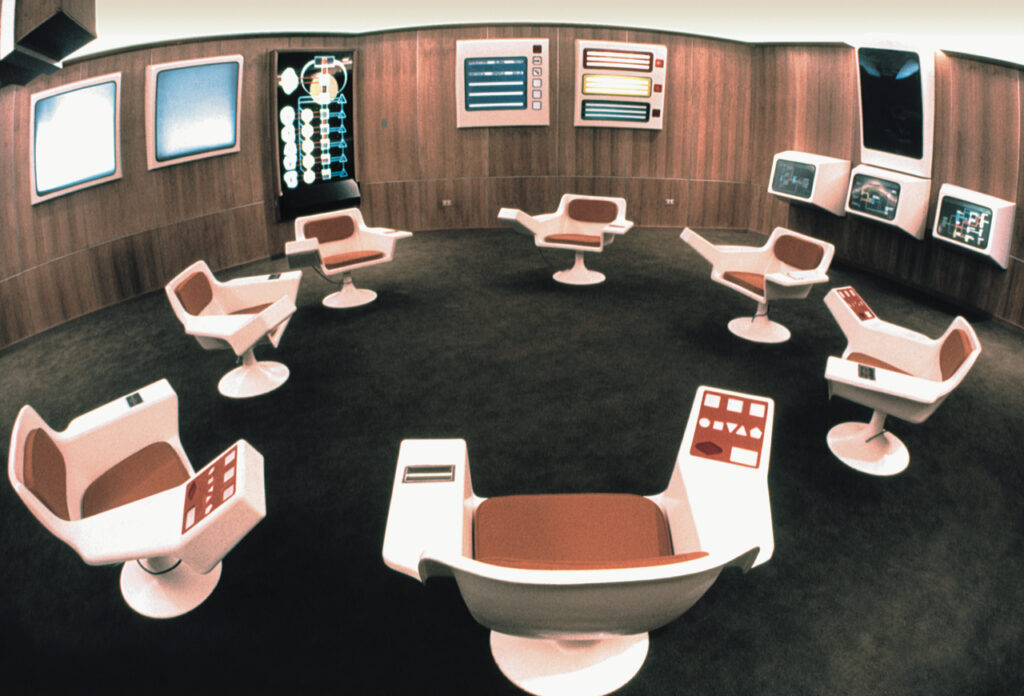
Cybernetic approaches were not popular in the 1950s. The HfG was one of the few institutes of higher education that acknowledged or adopted cybernetics at all. Thanks to this exception, in 1971 I was asked to set up a design group at the Institute for Technological Research in Chile. I had met minister Fernando Flores, who was later influential in Salvador Allende’s government, in 1970. On a visit, he discovered in my library the book Decision and Control by Stafford Beer. Later on, when we were friends, he admitted that initially, he had had no high opinion of architects and designers; he thought that they were bumblebrains. But when he saw Beer’s book, he revised his judgement, saying ‘At the time, just two people in Chile were familiar with this book.’ Without this coincidence, I wouldn’t have been able to do the work on the legendary Opsroom.[1]
Did you continue to work in a teaching capacity after your move to South America? Have you been able to adopt a similarly experimental approach to these projects?
I was primarily collaborating on drafting programmes for industrial development, although I was also contracted to train designers and advise companies in Chile and Brazil. Generally speaking, the HfG was well-known at the institutes of higher education, and there was a lot of interest in learning at first hand details about the training at the HfG. In Chile I was asked to teach specific design skills to students in the faculty of machine engineering at the Catholic University of Chile in Santiago. Although they mastered the mathematical processes required to calculate technical details, they fell short, were helpless when it came to developing alternative design concepts.



We’re painfully aware of the pitfalls of such a broad question, but would like to ask you for the sake of having closure: is the Ulm approach still relevant? Are you hopefulabout the emancipatory potential of today’s design education in view of the political, ecological and technological challenges of the present?
I am not familiar enough with the current state of design education in Germany to be able to answer that question, that is, to have anything but a personal opinion. As for the periphery, the Ulm approach has lost none of its topicality, especially as a counterbalance to the increasingly marketing-orientated design education and the revival of the artistically inspired understanding of design which is thriving in particular in proclamations about design being, in a manner of speaking, a fashionable business, with all the excitement associated with that. Whether studying art history is the right way to gain access to the subject of design is still very much open to question. With the launch of programmes leading to MAs and doctorates in the field of design, the theoretical output has increased considerably. But at the same time, there is a risk of academisation and a drifting apart of theoretical and practical competence. The original ‘Ulmers’ are unlikely to have been infatuated with the self-indulgence of ‘creative thinking’. Environmental problems including the climate crisis have grown at breathtaking speed since the closure of the HfG. And yet, the Ulm approach was broad enough to adapt the curriculum to this topic.
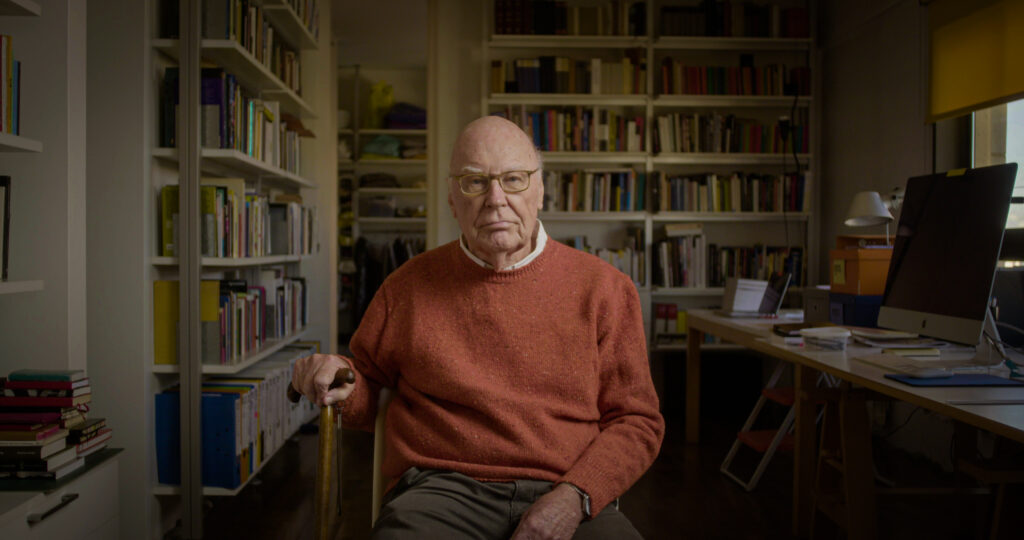
Designer, author (b. 1934). Studied at the Ulm School of Design (Information Department) (1955-1959). Taught and conducted research at the HfG until 1968. Since 1968, design and consultancy work in the field of development and industrialisation policy in Latin America (Chile, Argentina, Brazil). 1970-1993: Head of the design group at the Institute for Technological Research in Santiago (Chile), where the emblematic Cybersyn project was developed. 1973 – 1980: Director of the design agency MM/B in Buenos Aires. 1981 to 1987: Worked in the National Committee for Scientific and Technological Development in Brazil. 1987 to 1989 software design in a software house in California, specialising in interface design. 1993-2003 professor of interactive media at KISD Cologne. Courses and seminars at universities in Europe, Latin America, North America and Asia. Lives in Brazil and Argentina.