The cognitive shift in architecture. Exploring the interplay between mind, space and design
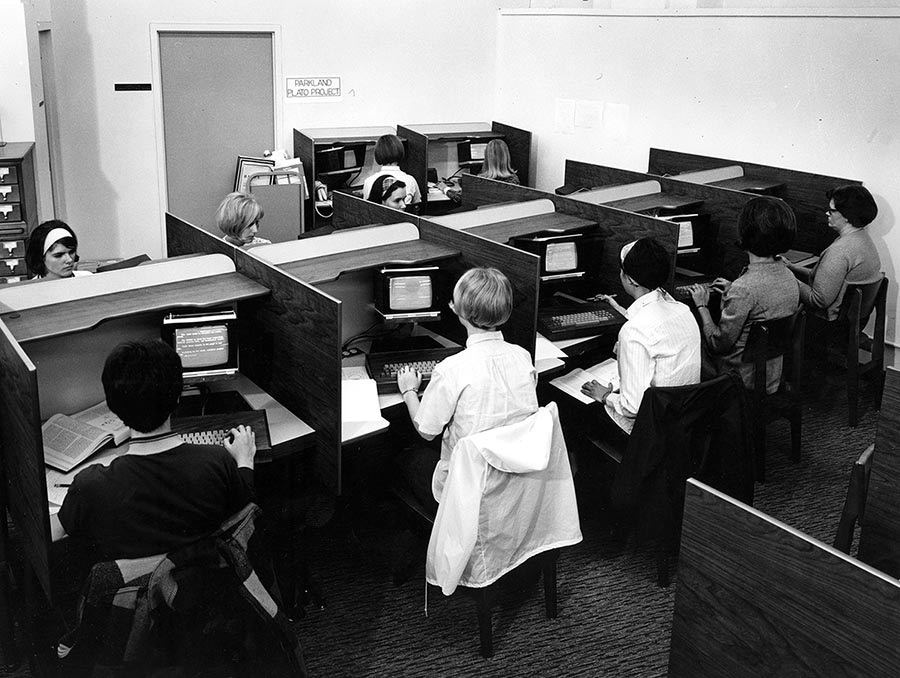
In the 1960s, teaching machines were the drivers of a revolutionary movement in education, the repercussions of which are still being felt today. What began as an experiment in cybernetics in think tanks and research institutions soon spread worldwide.
The idea that intelligent machines could automate the learning process was a global phenomenon that developed dynamically especially in Germany and the USA, influencing architecture and design. Here, Germany with its deep-seated tradition of humanistic education was thrust up against a technological avantgarde. The notion that machines could make education more efficient shook the foundations of a social educational ideal based on holism and social reform.[1]
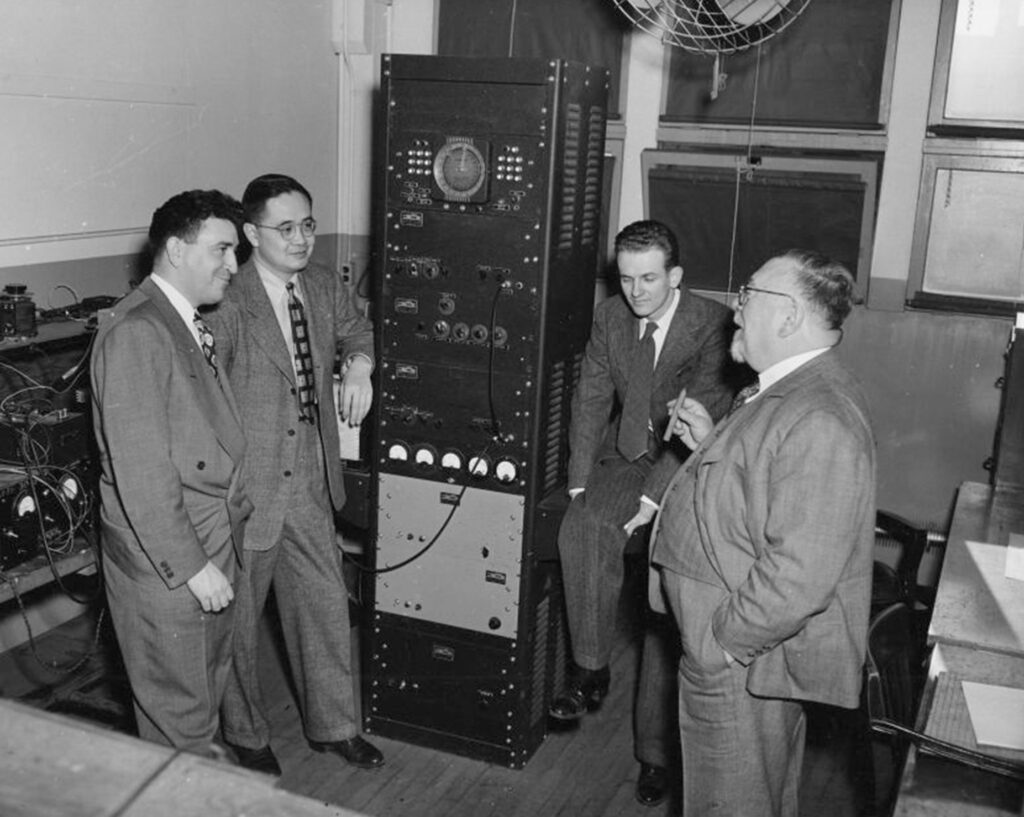
Helmar Frank, a former university-track secondary school teacher and student of the philosopher Max Bense, was a key figure in this development. His book Kybernetische Grundlagen der Pädagogik,[2] published in 1969, brought the fresh wind of technology to the musty education infrastructure of post-war Germany. For Frank, cybernetics was more than a new form of mathematics; it was a kind of universal vision, the objective of which was to reorganise all of society. He saw learning machines as a promising means to liberate lessons from the shackles of traditional, slow teaching methods. Education was to leave behind the leisurely pace of the humanities and take on the rapid pulse of the machines. The provocative title of his book thus aimed directly at ‘analysts, planners and technicians’, indicating a radical break with classical education: knowledge was to be systematically divided up and conveyed by machine.
At the same time, on the other side of the Atlantic, the ‘Sputnik crisis’ of 1957 radically changed the American education infrastructure.[3] The space race sparked a surge of innovation in its educational policies driven by the fear of falling behind the Soviet Union in terms of technology. The USA’s response was to massively upgrade its educational system. So-called teaching machines like the highly popular system PLATO (Programmed Logic for Automated Teaching Operations) were introduced, dividing learning materials into small standardised units known as learning quanta.[4] The aim was not in-depth knowledge, but maximum efficiency. Here, knowledge was industrially processed, like a product to be consumed sequentially from a conveyor belt. The automation of teaching was accompanied by an automation of learning in a flawless control loop comprising hardware, software and user. During this phase, the relationship between man, space and machine changed fundamentally. A new chapter began in education that continues to have an impact today.
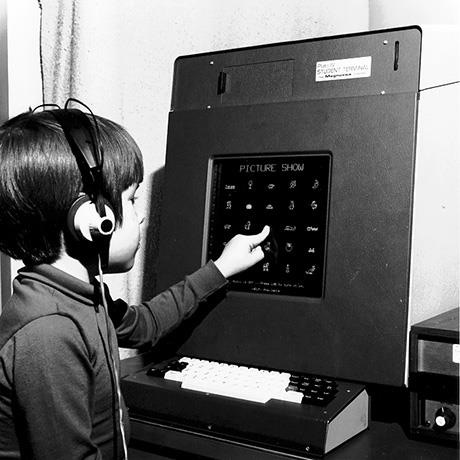
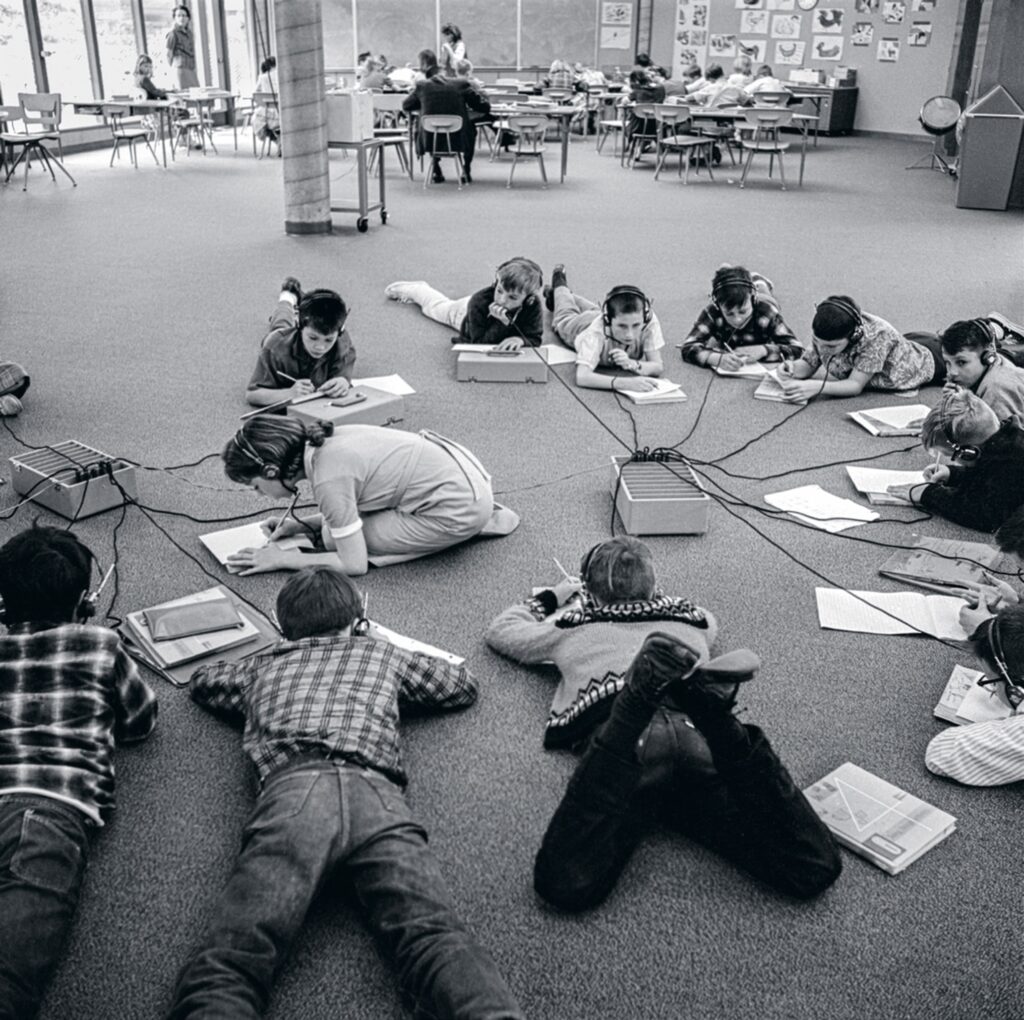
While the precise instructional logic of teaching machines was being honed in Germany, people in the USA were thinking in broader terms. Here, the cognitive psychologist George A. Miller precipitated a radical paradigm shift. In his essay ‘Some psychological perspectives on the year 2000’, published in 1967, Miller proposed a scenario that turned the education system of the day on its head: a classroom divided into small, semi-isolated cabins equipped with headphones, keyboards, screens and a ‘light gun’, all linked to a central computer. Miller writes: ‘A student communicates with the computer by typing on the keyboard or by touching his light gun to designated spots on the screen; the computer communicates with a student by playing recorded speech through the student’s earphones, or by writing or drawing pictures on the cathode ray tube.’ What sounded like science fiction, Miller saw as a future within our grasp. Learning should be individual, flexible and interactive. Students would be able to learn at their own pace, free of the rigid boundaries of traditional teaching.
Miller admitted that ‘for many people the computer is synonymous with mechanical depersonalization.’ But at the same time, the computer ‘gives the child a measure of individual attention that he could receive in no other way, short of a private tutor.’[5] This shed light on the connection between the ideal of individualism, digital technology and educational capitalism – a triumvirate of early machine learning. This concept disseminated the idea of using technology to improve an individual’s functionality and thus promised not only greater efficiency, but also a new form of democratic community.
Miller’s approach indicated a revolution in educational thinking – away from behaviouristic control and towards cognitive interaction, bringing the inner workings of thinking to the fore. This ‘cognitive shift’ radically challenged the dominant paradigm of behaviourism disseminated by B. F. Skinner,[6] who regarded the individual as a ‘black box’ whose behaviour could only be explained by external stimuli.
By contrast, cognitive science focused attention on the inner workings of the mind. Supported by Noam Chomsky, Miller argued that complex learning could only be understood through the study of cognitive processes. It was a rediscovery of thinking – and of space. Miller may certainly be mentioned in the same breath as the architect and urban planner Kevin Lynch – even if such comparisons are invariably somewhat unsatisfactory. At MIT in the 1960s, Lynch made empirical studies of how people perceive a city, and today he is still regarded as an important figure in the fields of environmental psychology and spatial cognition. Both men helped architecture to rediscover space, albeit on different levels and in separate technological contexts. Lynch focused on urban spaces, worked with maps, memory protocols and diagrams while Miller explored spaces of learning with learning machines, feedback systems and digital networks.
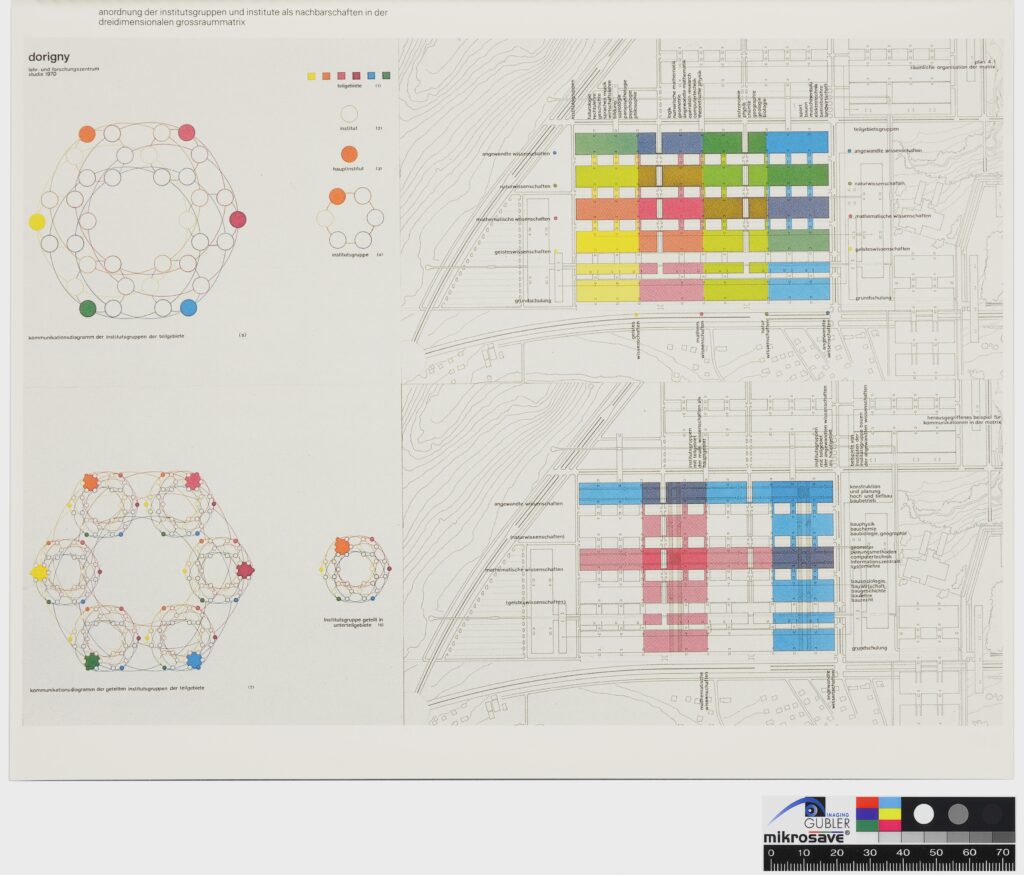
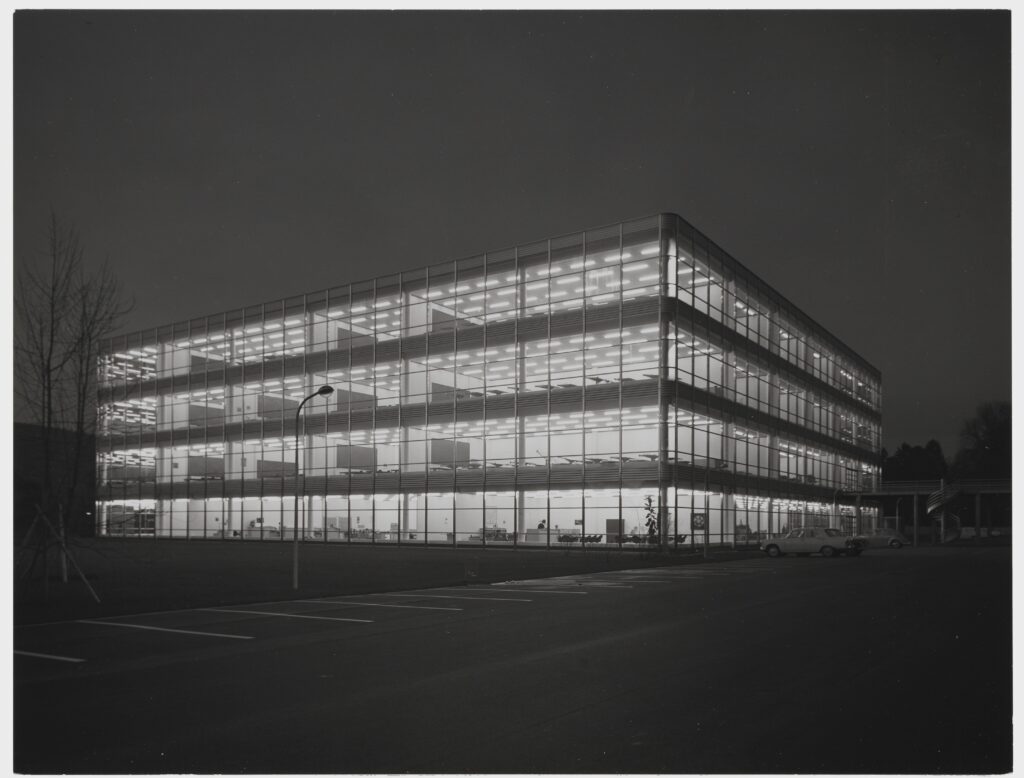
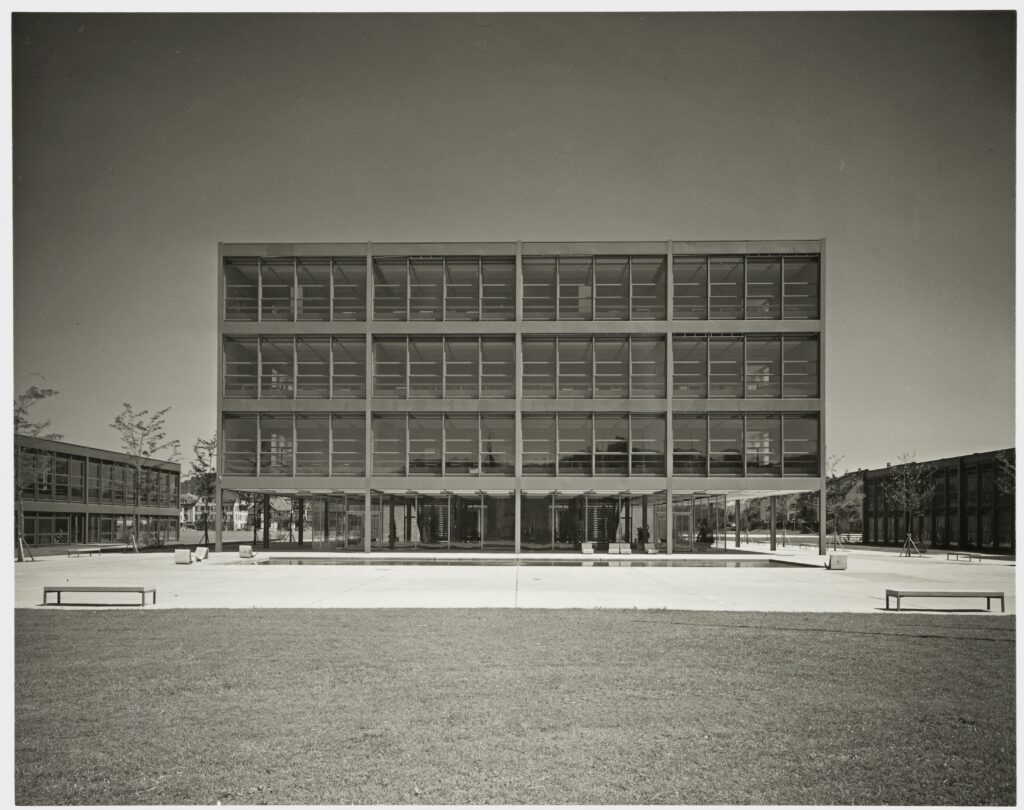
Educational reformers in Germany and Switzerland took up Miller’s ideas a little later, but they were no less ambitious. In West Germany, industrial-style school buildings such as those of the universities of Bochum and Dortmund symbolised the desire for reform that prevailed in the 1970s. Attempts were made to radically modernise the outdated education system. Ernst Ulrich von Weizsäcker’s education manifesto Baukasten gegen Systemzwänge[7] brought to the table the idea of modular learning structures designed to strengthen research-based learning and an interdisciplinary approach. American models provided inspiration, but the concept remained rooted in the German educational infrastructure. While in Germany the categories of industrial building systems persisted, the Swiss had already gone one step further. The architect Fritz Haller of Solothurn had been designing innovative buildings for schools and universities since the 1950s and set new benchmarks with his USM Haller building systems, modular structures that gained international recognition.[8] Haller submitted a visionary proposal to a design competition for a new university campus for the École Polytechnique Fédérale de Lausanne (EPFL). He shifted the focus from mere building systems to a technological communication network. He argued that the university was no longer a fixed, unchanging building but a living hub in a global network connected by telephone, television, digital data networks and high-speed trains, ready for the era of high-speed communication. He wanted to transform universities into open ‘cultural hubs’ that influenced not only academic discourse but also society at large. This network concept was central to Haller’s vision. In the 1970s, he collaborated with Konrad Wachsmann at the University of Southern California in Los Angeles, developing basic research focused on the future of building.
Haller identified a ‘general trend towards change’ in school architecture, which was to unfold in four stages, moving away from the traditional hierarchical model and towards flat hierarchies. First, Haller writes, the school principals would become superfluous, followed by the teachers. Conventional teacher-led lessons would be replaced by new forms of team teaching and collaborative learning. This trend peaks with the school as an open network of people, information and machines, an interdisciplinary hub connecting learning, technology and society —almost as if Haller had translated Miller’s vision into architecture. Haller assigned a specific built structure to each of these stages. While the first three stages leaned upon Haller’s own school buildings, for example the Kantonsschule Baden (1957–1964) and the Höhere Technische Lehranstalt Brugg-Windisch (1961–1966), in the fourth stage he went a step further, designing an open-plan school as an all-round open system. Here, rooms could be partitioned off as required to suit the optical, acoustic and climate requirements of each class. Haller’s vision was radical in that it viewed the teaching space as an adaptive, networked organism that systematically reorganises itself, anticipating the present-day concept of flexible learning environments and hybrid teaching.
By the late 1970s, the heyday of visionary school building projects was over. Fritz Haller’s radical concept of a network university foundered too. The competition jury found his ideas too progressive, too impractical. Disappointed, Haller reported to the systems research study group in Heidelberg co-founded by Horst Rittel: ‘The experts called the work interesting, but too progressive, too inhuman, too un-architectural. Perhaps something like it can be built in the future.’[9] Nevertheless, Haller remained true to his vision. Almost 30 years later in 1996, shortly after the creation of the World Wide Web at CERN, he was convinced that ‘schools will no longer be schools. They are the communication hubs of a global network of relationships and data in which people of all levels of knowledge and social ranks are active and establish new values.’[10] Haller’s idea was ahead of its time—a place of learning that transcends physical space, expands into the digital network and transforms the school into a dynamic centre of global knowledge production.
From the post-industrial society, which replaced traditional factories with knowledge-based economies, and the network society, which reinvented the world as a complex web of connections and information streams, to today’s data society, which is shaped by intelligent assistance systems and artificial intelligence, the question of learning is more critical than ever. The cybernetic vision—learning as a control loop of feedback and adaptation—has spread out and evolved. It is some time since machines were silent instruments; they now entangle us in an endless dialogue as if at a never-ending cocktail party during which we are continually engrossed in conversations or being asked new questions, our thoughts constantly steered in different directions. What once began as a technocratic experiment has transformed, giving us an open learning infrastructure in which man and machine generate knowledge together.
The challenge now is to not only embrace these dynamic learning environments but also to examine them with a critical eye, with an awareness of the power of algorithms and openness to the opportunities of a co-evolutionary future of learning. The tables have turned because machines are no longer teaching only us; by now, machines are teaching machines, and we find ourselves in a curious dual role as both teacher and student in a network of neural connections that we have built for ourselves.
Man is faced with the glorious, but also open-ended task of curating this machine-to-machine learning process. Instead of specifying linear educational routes, we are standing on the precipice of a vast knowledge eco-system in which synthetic data, assistance machines and human experience meld together.
We must develop new pedagogies, the aim of which is to not only communicate immutable contents, but also understand the changing nature of knowledge and the dialogue between systems. It is a form of learning that lacks a solid footing, that wavers between hypotheses, datapoints and patterns that are in a constant state of flux. This is less about the control of information and more about shaping the conditions under which knowledge can be generated in the first place.
In this age of conversational technologies, we thus become communicators, designers of new forms of learning in which data are viewed not only as facts, but as narrative elements of a consistently expanding dialogue. Herein lies perhaps the real challenge and at the same time the great promise of our digital present day—to create a new culture of learning that is just as fluid, connected and adaptive as the technologies that it drives.
is Professor for Theory of Architecture and Digital Culture and Head of the Design, Data and Society Group at the Faculty of Architecture and the Built Environment at the Delft University of Technology, where he also leads ‘The New Open’, an interdisciplinary research project exploring the impact of open data on design and social change. Georg Vrachliotis earned his Ph.D. from ETH Zurich and served as the Dean of the Faculty of Architecture at the Karlsruhe Institute of Technology (KIT) from 2016 to 2020, simultaneously holding the position of a professor of architectural theory focusing on digital culture. Throughout his career, Georg Vrachliotis has curated several international architecture exhibitions, including Fritz Haller: Architect and Researcher at the Swiss Architecture Museum in Basel (with Laurent Stalder, 2014), Sleeping Beauty: Reinventing Frei Ottos Multihalle at the Architecture Venice Biennale (with Sally Bellow, 2018) and Models, Media and Methods: Frei Otto’s Architectural Research at the School of Architecture, Yale University (2020), among others. He is the author and co-author of several books, including The New Technological Condition (2022), and serves as a member of the advisory board of the esteemed journal ARCH+ and as an external examiner at the Bartlett School of Architecture, UCL London.