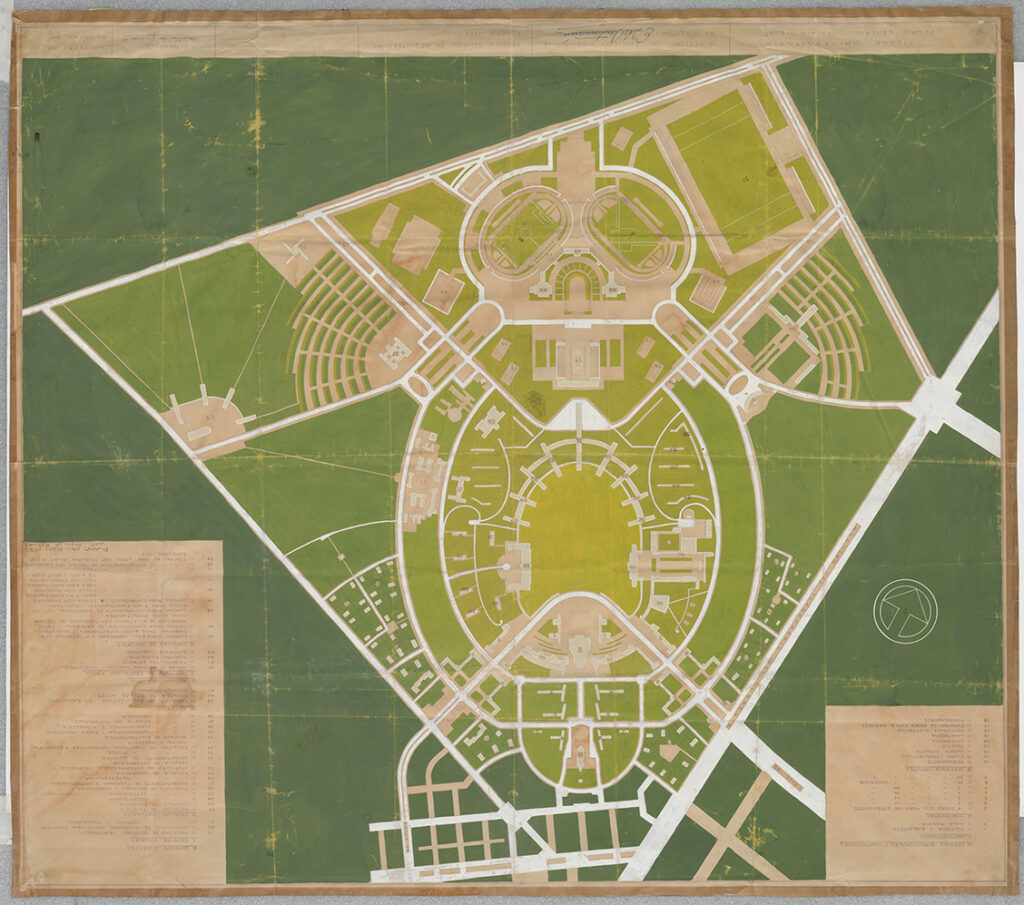
The general layout of the University City of Bogotá is often described as ‘owl-shaped’, an image which emerges in the master plan developed from 1936 to 1940. The characteristic silhouette is created by a symmetrical arrangement of the main building axes, which extend laterally like wings while key faculty and administration building form the ‘head’. This perception is less the result of a deliberately zoomorphic design than an expression of Leopoldo Rother’s both rigorously rational and organic approach to design. The functional zones of the campus are logically grouped around central circulation axes whose curves and proportions, seen from the air, create a form which is virtually owl-like.
The ‘owl’ is thus an interpretative, symbolically powerful, image. It accentuates the role of the National University of Colombia as a locus of knowledge, wisdom and scientific vigilance, properties which are traditionally attributed to the owl. At the same time, the form testifies to Rother’s ability to combine functional modernism with a subtle, undogmatic integration of the landscape. The owl metaphor thus offers an additional interpretation of the campus, not merely as a rationally designed ensemble, but also as a cultural symbol of an intellectual domain at the heart of Bogotá.